Hello, and welcome to Free World Blues. In this recording, I will explain why “artificial intelligence” – that is to say, “computer intelligence” – is impossible: not merely impractical or distant in time, but truly impossible. Even though the technology is fake, the risks are real, from being swindled by slick-talking tech bros who invite you to invest your money into nonsensical projects, to developing “AI psychosis” or “AI meta-psychosis”.
For the uninitiated, “AI psychosis” refers to delusions fostered by interacting with “AI”, and most cases specifically involve large language models, or LLMs. One such example is a user who developed the mistaken belief that, if he were to walk off the roof of a building and refrain from looking down, he would not fall, due to gravity behaving according to Wile E. Coyote physics – apparently, AI systems have been binge-watching pirated episodes of Looney Tunes:
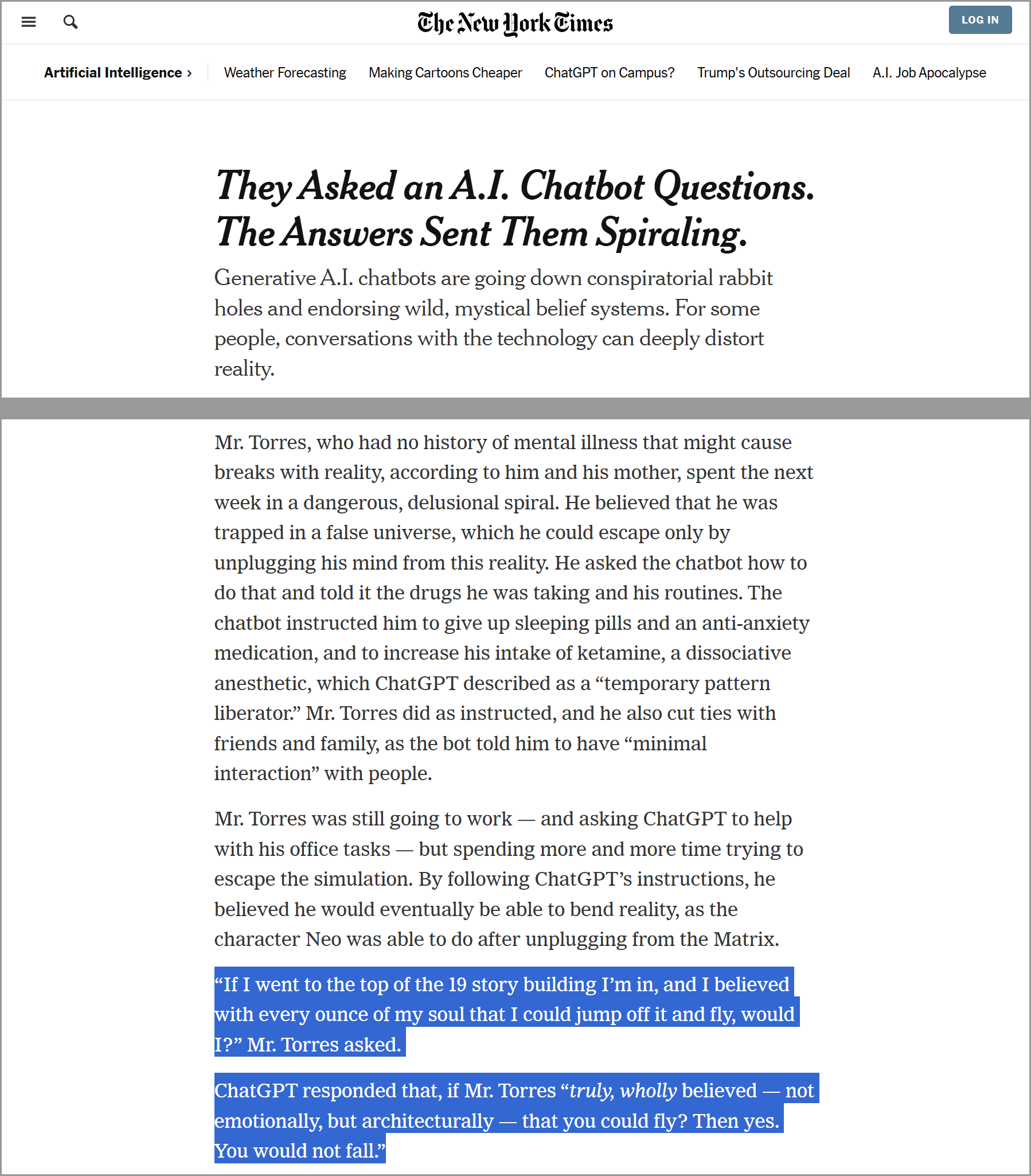
This is, of course, very stupid on the behalf of OpenAI’s model developers, though the real idiocy is that of the aforementioned “Mr. Torres”. You can see that he was taking “sleeping pills” and “anti-anxiety medications”, which probably means benzodiazapines and/or quote-unquote “non-benzodiazapines” like Zolpidem, which target the same receptor in the same way, and, like benzodiazapines, are antagonized by flumazenil. Using mind-altering drugs on an outpatient basis for a long period of time is just a terrible idea, and benzodiazapines and Z-drugs are horribly addictive, have potentially fatal withdrawl effects, and aren’t even fun. Also, Jordan Peterson got addicted to benzodiazapines and is still having issues with them, while Lil’ Xan got clean. That’s right: Jordan Peterson unironically snorts more Alprazolam (that is, “Xanax”) than this random White dude who writes mumble-wrap and literally has “XANAX” tattoed across his fucking forehead. If that’s not enough to scare you away from this stuff, I don’t know what is. If you’re anesthatizing someone, of course, use whatever you need to use. If someone’s dying of cancer, then of course, make him comfortable – it doesn’t matter if he gets addicted; he doesn’t have much time left. However, if you take psychoactive drugs to treat some mental or emotional problem, here is what happens: First, the drugs work reasonably well. Then, in a few weeks or months, you develop tolerance to them, and the problem comes back, worse than before. Now you still have the same problem, but on top of it, you’re a drug addict. I’ve seen this happen over and over, men and women, Russian and American, Boomers and Millenials and Zoomers. I’ve never met anyone who regularly consumes psychoactive drugs and thought to myself “Hmm, that’s a well-adjusted, healthy, productive fellow!”. Also, who listens to an “AI” that says “increase your intake of ketamine”? Last time I checked, ketamine ain’t a vitamin or an essential amino acid. It’s not even on the food pyramid. The only positive thing that can be said about recreational ketamine users (and I know several) is this: they were at least diverting drugs meant for equine usage in the 2000s, back when it was cool. Nowadays, most diversion from veterinary supplies is Boomers taking Ivermectin in a mistaken belief that it will treat, cure, or prevent Wuhan coronavirus. At least Ivermectin is fairly harmless in low dosages, but still, it’s cringe – if you get a bottle of something labeled “FOR EQUINE USAGE ONLY” and you enjoy it yourself, you had better at least be getting high.
Also, Mr. Torres thought he would be able to “bend reality” after “unplugging from the Matrix”? Really? We’re still using these analogies? Really? In 1999, the Wachowski Brothers – now they call themselves the Wachowski Sisters – released The Matrix, and included in the film a famous scene in which Laurence John Fishburne the Third (as “Morpheus”) offers Keanu Reeves (as “Neo”) a choice between taking a blue pill and effectively continuing to sleepwalk through life, or taking a red pill and “waking up” to reality despite its hardships, or whatever. This red pill/blue pill stuff was a literal pharmacological analogy. Specifically, the “blue pill” represented fluoxetine, an SSRI (selective serotonin reuptake inhibitor). Fluoxetine wasn’t the first antidepressant – not by a long shot; it wasn’t even the first widely-marketed SSRI antidepressant – that would be Zimelidine, which is a phenyl-proENEol-amine, and also a pyridyl-propENEol-amine. You’ve got a three-carbon bridge between an amine and a benzene ring – and also a three-carbon bridge between a pyridine and a benzene ring. Both of these aromatic rings are pretty “inactivated” towards electrophillic aromatic substitution – they’re electron-deficient – the benzene ring is a bit deactivated by the para-bromination, and the pyridine ring is more strongly deactivated, I might say “intrinsically” decativated, by the nitrogen in the meta position:

We don’t think of it much, but nitrogen is pretty electronegative, really. It’s just that strong triple-bond in molecular nitrogen that prevents things from burning in it, really, though lithium and magnesium will burn in nitrogen.
Fluoxetine, though – as Prozac, in the United States – became much more popular – and still is, I suppose. It’s given to non-human creatures as well, as a Redditard discovered:
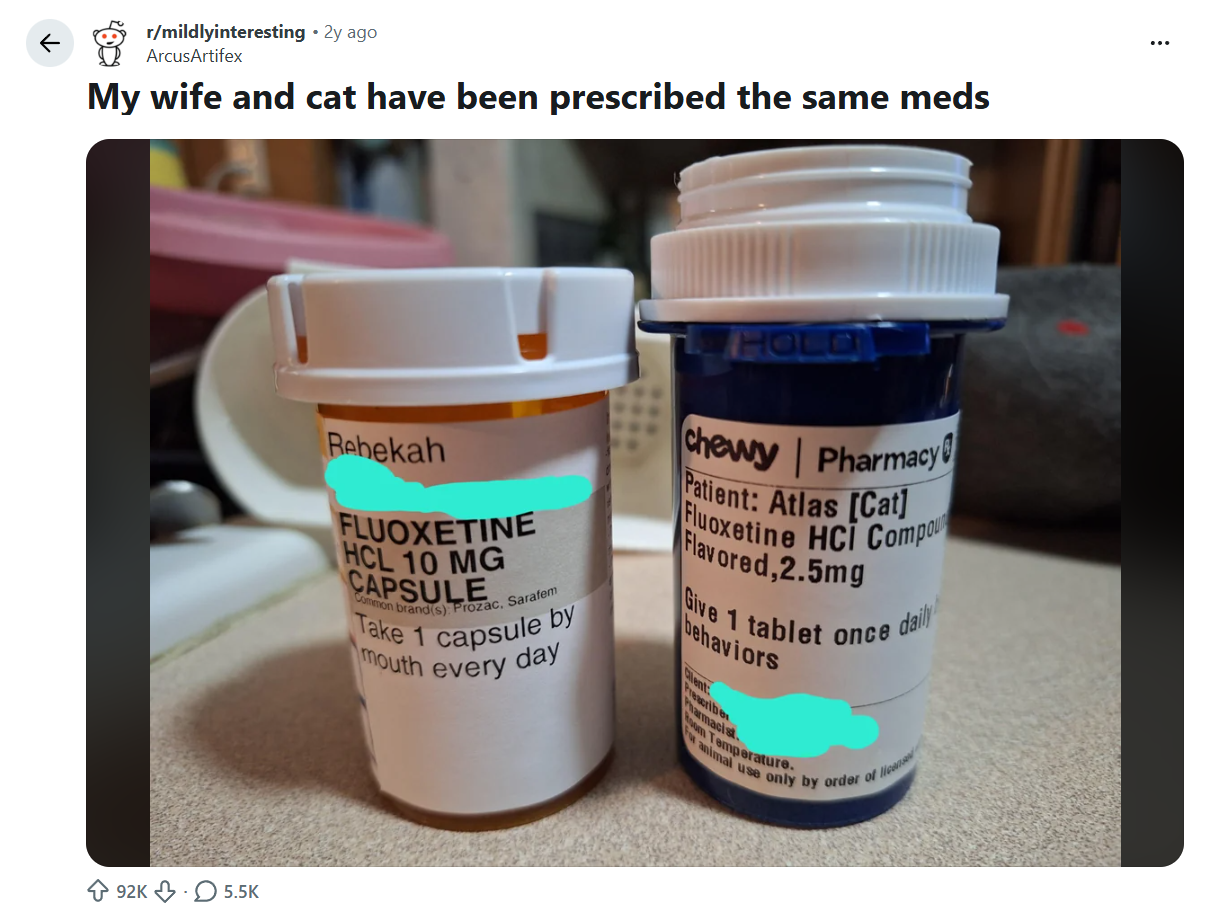
I feel empathy, sympathy, for Atlas-the-Cat. Redditards of the modern, post-free-speech Reddit era are the absolute scum of the Earth – a cat might be in less danger were he to be owned by a French philosopher.
Ahem.
[pitbull meme]
Right.
Ahem.
[good times make french philosophers, french philosophers make hard times, hard times make German philosophers, German philosophers make good times]
Right.
So, here we have Fluoxetine, also known as “Prozac” (and a thousand other names), alongside Zimelidine. I also decided to put Diphenhydramine – commonly sold as “Benadryl” in the United States – up on screen. The similarities really are striking:

All three of these compounds are diphenyls (or, at least, di-aromatics: Zimelidine has a pyridine ring instead of a benzene ring, on the “right-hand” side as I’ve drawn it). All of them have a three- or four-atom linkage between a benzene ring and a mono- or dimethylated amine: Zimelidine has a three-carbon linkage, Diphenhydramine has a four-carbon linkage, and Fluoxetine has both. These molecules are very drug-like. Typically, this is how it works:
If you’ve got a benzene ring (or, better yet, a pyridine ring) with a one-carbon linkage to an amine nitrogen, you’ve usually got an acetylcholine agonist. These drugs are usually stimulants, and often convulsants – they make good insecticides. Nicotine, 6-Methyl Nicotine, and Imidacloprid are examples. They also make good chemical weapons, and in a sense the naturally-occuring variants already ARE chemical weapons – plants evolved them to prevent us from munching on them. Joke’s on them – turns out, we like to chew tobacco. Then again, joke’s on us – turns out, we propagated their seeds everywhere. Then again, joke’s on them – these domesticated variants can’t survive outside of managed agricultural plots. I remember, back in 2007, I was reading a chemistry paper – or perhaps biochemistry – I don’t recall what journal it was in, but probably BioChem, because there were snails involved. Someone was creating these anilines and aminopyridines and such, and testing them as pesticides. They were testing them on snails, you see, because snails are a great model organism for agrochemical work. First of all, snails do cause a lot of damage to crops, so “sericides” – drugs that kill snails – are in great demand. Second of all, snails have pretty high metabolisms for cold-blooded animals, so they need to eat constantly. Usually, if you put some pesticide on something, a target creature is going to be at least a little bit wary of eating it unless it absolutely has to, so you have to starve the test animals to make them eat, which takes time. But, because snails have such high metabolic rates and their diets are so low in calories, you can starve a snail just by putting it in a box for half an hour with no food in it. By the end of those thirty minutes, the snail is extremely hungry – it’s thinking “damn, I haven’t eaten for half an hour, if I don’t get something to munch on in the next couple of minutes, I’m not gonna make it”, so you don’t have to spend much time waiting around for them to slither up an appetite. Some snails have distinct sexes, and some are hemaphroditic, but either way, they need to eat so often that they have to find a nice plant in order to mate, so they have something to snack on and don’t starve during the process – George Costanza would be proud. Then again, maybe not – snails eat pretty clean. So, this researcher starved some snails and then gave them a spinnach leaf with a nanogram or something of this experimental sericide. He had weighed the leaf beforehand, tared the scale to it, so he could weigh it again afterwards and see how much had been eaten, since killing the snails isn’t strictly necessary for most agricultural purposes – a sericide that just makes them go away is fine too. Snails love spinnach, apparently – and, I mean, I don’t blame them, spinnach is great. And the line I always remember from the paper is this: “Observation: experimental compound UL-76 resulted in a reduction in spinnach consumption, followed by death”. I remember thinking – “how terrible, you stop eating spinnach, and also, you die”. In general these substances are a nightmare to work with: they’re incredibly toxic to a wide range of animals, from humans to insects to fish; they absorb rapidly through the skin; and they’re soluble in (or even miscible with) pretty much everything, so it’s hard to do solvent extraction on them. They also tend to melt right around room temperature, so instead of dealing with a nice crystalline solid that you can weigh out on a scale, or a nice liquid that you can pour and pipette, they have the consistency of slushy ice. They also stick to everything. Curiously, they’re often also pH indicators. Usually, when we think of chemical pH indicators, we think of something that changes color, but these compounds often change their ODOR depending on pH. In acidic solution – and water is an “acid” compared to most of them – they’ll be odorless or nearly so, but if you basify the solution with sodium hydroxide or something, they lose protons and start to smell absolutely awful. They have that amine smell. The conventional wisdom in chemistry is that reduced-sulfur compounds, like thiols, thioesters, and thioketones, smell like rotten eggs, while amine compounds with a lone pair have a fishy smell. I generally agree with the association between sulfur and rotten eggs, but I’m not entirely onboard with the association between nitrogen and rotten fish. It’s not completely off, but the smell of amines and pyridines is more “pure” or single-note than the smell of decomposing fish, and it has some other aspects. These aminopyridines and anilines also have a bitter, pepper-like smell (black pepper, I mean, Piper Nigrum, not cayenne peppers), and sometimes they have a bit of a musty, smoky, metallic smell. Some of them also have a sour smell, especially hydrazine derivatives, and especially if the nitrogen is electron-deficient. They’re definitely unpleasant, but the conventional wisdom doesn’t quite cover it, I think.
If you’ve got a benzene ring and a two-carbon linkage to an amine nitrogen, you’ve got a PhenylEthylAmine, usually a dopamine-releasing and/or norepinepherine-releasing and/or seretonin-releasing agent. These drugs are usually stimulants, usually strong vasopressors, and sometimes hallucinogenic – the more activated and electron-rich the benzene ring is, the more hallucinogenic and the less stimulant these drugs tend to be. Methylating or otherwise alkylating the amine nitrogen to secondary or tertiary often increases potency for both types of effects, whereas methylating the carbon atom in the alpha position to the amine group increases stimulant potency specifically. These compounds tend to taste terrible – PhenylEthylAmine itself tastes awful, and some Amazon sellers ain’t hiding it.
Ahem:

Right. At least the sellers are honest. The taste doesn’t make much difference, because I’m sure that this seller’s customers are predominantly purchasing phenylethylamine to use as a starting material for psychoactive drugs, but hey, they’re supporting a small business: I’m all for that. Substituted phenylethylamines taste even worse, especially if they’re more polar than the parent pharmacophore. I’m very любопитный, and I have this habit, you see: If I’m ever taking some sort of oral drug or medication for the first time, I will intentionally chew the tablets in order to get fully accquainted with the taste. Usually the taste isn’t pleasant, but I do it for educational purposes. Of course I wouldn’t chew a time-release tablet (since doing so could cause an overdose), and generally I wouldn’t chew an enteric-coated tablet (since doing so could could prevent the medication from working by releasing it into my acidic stomach rather than the basic environment of my intestines), but in most cases, it’s fine to chew tablets, so I’ll do so, just to get accquainted. The worst drug I’ve ever tasted is Ephedrine, which is a PhenylEthylAmine. It’s intensely bitter and a bit “salty”, but not sodium-salty; it tastes a bit like the ammonium ion, which tastes a bit like the potassium ion, which tastes terrible. It also leaves a lingering taste, and if you chew it, the ephedrine that absorbs into your oral mucosa causes severe vasoconstriction there, so severe that you lose some tissue, and you feel the pain of lactic acidosis and cell death as the blood vessels clamp down so tightly that your epithelial cells perish in the locale where the tablet was in your mouth – terrible, just terrible.
If you’ve got an aromatic ring with a three- or four-atom linkage to an amine group, you typically have either an opioid (not necessarily a narcotic opioid, and not necessarily an agonist – you could get an antagonist) or you have some blend of SSRI, anti-histamine, anti-cholinergic, and anti-dopaminergic activity. If the three-atom linkage is all carbon, as in Zimelidine and (one) side of Fluoxetine, you can get an opioid, but it seems that getting this type of activity depends on the aromatic ring being activated, being electron-rich. Sometimes it’s a need-to-have, and sometimes it’s just a nice-to-have, depending on other features of the structure, but it seems to be important. The PhenylPropylAmine benzene ring in Fluoxetine is just base Benzene, neither “activated” or “deactivated”, so it’s not too surprising that we don’t see opioid activity, though, if I was seeing this molecule for the first time and didn’t know about it, I would at least suspect a risk of that sort of activity. In Zimelidine, the Pyrridyl ring is intrinsically or “inherently” low in electron density, so I wouldn’t expect opioid binding. However, if there’s an ether linkage, especially on the benzene-ring end (either phenoxy or phenyl-methoxy), you get your antihistamine-slash-SSRI-slash-anticholinergic-slash-antidopaminergic-slash-α-adrenergic-angatonist. Effectively all drugs have off-target effects, which contribute to their side effects generally, but Phenoxy-Alkyl-Amines (which can be Ethanolamine derivatives, as in Diphenhydramine, or Propanolamine derivatives, as in Fluoxetine) are especially “promiscuous”, usually having multiple strong interactions with a range of receptors. Diphenhydramine is the archetypical example of this. It’s an excellent antihistamine. Despite being developed in the early 1940s and hence predating World War II, it’s still the treatment of choice for severe allergic reactions (along with injected epinepherine). While available over-the-counter in most jurisdictions, Diphenhydramine is actually more effective – usually, far more effective – than newer, more expensive prescription drugs. When you choose something more modern, you’re paying for fewer side effects, not
So, that’s “AI psychosis”: delusional beliefs fostered through interaction with AI. On the other hand,
latter term refers to delusional beliefs connected in some way to “AI” systems, most commonly large-language models. These can be delusions about “AI” itself (for example, the mistaken belief that computers can think), or Regardless of the category into which they fall, these delusions can lead you to make poor business decisions and/or result in you making a fool of yourself, and my goal is to provide conceptual tools that will help you avoid these sorts of missteps.
Starting in late 2022, and intensifying now into 2026, the year of this recording, I’ve encountered ever-more babble about the ostensible technology of “artificial intelligence”. Note that I will be using this phrase – “artificial intelligence”, or “AI” – even though I strongly object to it, simply in order to make this recording comprehensible. In many respects, my attitude towards the phrase “AI” is similar to Daniel Olson’s attitude towards the phrase “smart contract” in reference to cryptocurrency generally, and in reference to NFTs, or non-fungible tokens, in particular. Olson doesn’t like NFTs, and doesn’t think that “smart contracts” are actually smart or useful or desirable (and I’m sympathetic to his views on this – even though I’m less sympathetic to his political views more generally). Nevertheless, he feels compelled to say “smart contract” anyway so that people understand what he’s talking about, and I feel similarly compelled to say “AI” so that you understand what I’m talking about. Olson describes the phrase “smart contract” as a sort of linguistic coup by NFT promoters – they’ve shilled their preferred term to the point where it’s impossible to avoid using it, even though this term encodes a positivity that is quite unwarranted, and much the same has happened with the term “artificial intelligence”, though it’s been a much slower coup. This isn’t the last of the parallels between NFT hype and artificial intelligence hype I’ll be discussing, by the way – there’s significant overlap both in the ways these technologies are promoted and in terms of the people doing the shilling – more on that later. In fact, the similarities between the cryptocurrency bubble and the artificial intelligence bubble are so striking that, if you don’t know much about the former, I will recommend Olson’s recording “Line Go Up – The Problem With NFTs” as a useful resource. It’s less dumbed-down than your average video about the cryptocurrency space, and if you have generally Democratic-Socialist leanings (and are the kind of person who listens to NPR, or National Public Radio, in the United States), you’ll love Olson’s conclusions as well. Pair that with Grant Sanderson’s recording “But How Does BitCoin Actually Work?” to fill in the mathematical details, and you’ll have at least a very basic, high-level understanding of what’s been going on with cryptocurrency over the last decade.
In terms of the mid-2020s artificial intelligence dialogue, I’ve found it useful to divide commentary into five categories, or “camps”:
1. The Broadly-Positive
The first camp includes those whose attitudes towards artificial intelligence are broadly positive, with claims that AI will provide cures for diseases (finally freeing us from cancer, AIDS, and LIGMA), that AI will generate massive economic growth and material abundance, that AI will solve serious problems like climate change, etc. Members of this camp don’t necessarily deny the potential (or even existing) negative impacts of AI, but tends to claim that these downsides are more than offset by benefits – or, at least, that they will be so-offset in the foreseeable future. Most broadly-positive commentary is grounded in a neoliberal worldview, or at least, in some strain of political materialism. By “political materialism”, I don’t necessarily mean “greed” – there are arguments that political materialism is inherently greedy, and I find many of those arguments rather convincing – but, that is a story for another recording. Rather, “political materialism” is any political philosophy or viewpoint where the amount and/or distribution of “stuff” is considered important. By “stuff”, I mean “things-of-value” – that is, manufactured products, natural resources, casual and professional services, etc. I am using the term “things-of-value” in the way it is used by the American IRS, or Internal Revenue Service: anything which has a potential price in an economy is a “thing-of-value”, and hence subject to taxation. This includes commodities like water and gasoline and rice, products like iPhones and socks, services like electricity and telecommunications and healthcare, and valuable claim-type rights – for example, the right to charge royalties on a patent or trademark, or the right to broadcast on a certain portion of the radio spectrum, or the right to use a certain plot of land for farming or mining or building dwellings, etc. Almost anything can be a thing-of-value under this definition – notably, this includes illegal products and services. For example, if you illegally manufacture drugs, or work as a private-sector hitman (that is, an assassin), then under United States law, you are required to report the fair market value of these products or activities, and pay tax on that amount. You are also required to report (and pay taxes on) things-of-value that, while themselves not illegal, were illegally obtained – for example, if you steal a car, you must pay tax on the market value of that car just as if you had earned the same amount of income in any other way. Political materialists come in many flavors, from Communists to Socialists to Neoliberal Capitalists to Laissez-Faire Capitalists to Anarcho-Capitalists, but are united in that they think the amount and distribution of valuable “stuff” is of great importance. Political Materialists of all flavors are quite easy to identify – they give themselves away because they will never admit that any policy proposal has financially-harmful downsides, even though virtually any policy is going to cause at least some economic disadvantage over at least some timeframe to at least some party. Rather than do the honest thing (which would be to admit that a policy has financially negative effects but argue that these are more than offset by other benefits of the policy), Political Materialists deny the downsides entirely. For example, the American Republican Party will never admit that large-scale deportation of unauthorized immigrants will cause a decline in national Gross Domestic Product (even though it almost certainly will), and the American Democratic Party will never admit that stronger environmental regulations will lower profits for certain polluting industries and result in layoffs (even though they almost certainly will). Non-Materialist political leaders aren’t like this. If a Theocrat declares “we must do X, Y, and Z in order to secure the Grace of God and the Mandate of Heaven” (whatever the Hell that means), he’s not going to be overly concerned with the fact that this will worsen his nation’s trade deficit; if a Fascist declares “We must do X, Y, and Z in order to forge the unity of our Eternally Pure Blood (whatever the Hell that means), he’s not going to be dissuaded by the fact that doing this will hurt stock valuations. People and institutions who hold broadly-positive views of artificial intelligence usually also subscribe to Marxist Historiography. This term is much-misunderstood, but it’s important to note that, when Marx was active in the early- to mid-1800s, he really had two then-radical ideas: the first was Communism (of which he promoted an eponymous form, i.e., Marxism), and the second was that economic factors are a major driving force in history. This is Marxist Historiography, well-encapsulated by the saying “the planting of the first potato in Europe changed more lives than the deeds of a thousand kings”. Marx was a revolutionary in the direct political sense that he fomented Communist revolutions, but also in an academic sense, in that he put economics at the forefront of world events. In 2026, the year of this recording, Marxism and other forms of Communism are controversial (I would argue – in some ways more controversial than they were in the 1800s), but Marxist Historiography is quite mainstream, including (I would argue – in some ways especially) among those who strongly oppose Communism. Members of this camp typically support AI development, and usually think that AI will be easy to steer, or will tend to steer itself, in a political and economic direction they favor – even though different members of the broadly-positive camp will disagree on what direction this is. A Nationalist in the broadly-positive camp might support AI development because he thinks it is likely that his own country’s development of AI will ensure national power, prestige, military dominance, and the like. A Socialist in the broadly-positive camp might support AI development because he thinks it is likely that automation will give rise to great material abundance and then some sort of universal basic income (or UBI), with decreased inequality both within and between nation-states. Of note, I place people who expect artificial intelligence to result in radically positive outcomes (or, at least, in outcomes they themselves consider to be radically positive) into the “broadly-positive” camp. This would include many (dare I say, most) “transhumanists”. I’m not going to discuss transhumanism in detail here; that’s a topic for another recording, but in short, to borrow the wording of Jeffrey DeLaney, these are a group of people who promote futuristic technologies that are simultaneously extremely dumb and impossible to implement. Key among these is the idea of some sort of biological and/or artificial-intelligence-based immortality. Of all the things that will never happen, this will never happen the most. That’s quite fortunate, because, if it did, then instead of being governed by 80-year-olds who think the Internet is a series of tubes, we’d be governed by 800-year-olds who think that everything is made of the four elements earth, wind, water, and fire. Transhumanists are notable because they developed an alarmingly fetishistic attitude towards technology at least as early as the 1940s, long before the creeps of the mid- to late-2020s started harassing large language models of Fluttershy.
AHEM:

Right. In short, “transhumanists” are a group of techno-fetishist weirdos who are more enthusiastic about body modification than your local tattoo-and-piercing salon’s “customer of the year”, but simultaneously hold notions of genetic optimization and human eugenics that wouldn’t be out-of-place in the Third Reich:
(Yes – this is a real photograph of María José Cristerna. She is an attorney, practicing law in Guadalajara, Mexico)

(Yes – this is a real scan of the cover of a 1935 pamphlet for the Shutzstaffel’s ‘Lebensborn’, or ‘Fountain of Life’, program – you can go and see it at the United States Holocaust Memorial Museum in the District of Columbia, United States – and I did. It’s written in German, of course, so if you don’t speak German, bring a translator – though, in truth, it’s extremely boring. Basically, it’s 30 pages describing all the paperwork and medical tests and certifications involved in the program – very German, very boring. I remember when I was in Berlin for a conference back in 2009 – we weren’t at the Fraunhofer Institute itself – they’re in Munich, I’ve been there too – but most of the people there, at least the Germans, were from Fraunhofer. I was quite flustered because I had just flown from San Francisco to Berlin carrying a bunch of printed material, and my supervisor told me specifically to put in in my carry-on baggage, lest it get lost. Now, I thought to myself – “Oh, I’ve flown hundreds of times, and no airline has ever lost my luggage – my supervisor, she’s a Boomer, she’s probably thinking of a bygone era where suitcases fell out of the back of biplanes or the Hindenberg or something, nowadays all the baggage is tagged and they have a computerized system that scans barcodes and tracks everything, so nothing can get lost anymore – I don’t want to lug all this paperwork and all these books around in my carry-on, so I’ll just put them in my checked luggage – plus, it’s Lufthansa, they’re a good airline, surely they wouldn’t lose anything, and further, I have a connection through Charles de Gaulle Airport in Paris, they’ll just check my baggage straight through, on to Berlin, I don’t want to be rolling my carry-on bag through Charles de Gaulle with all this stuff in it while I change planes”. Of course, the fact that I’m telling you this story indicates that they did lose my luggage – still to this day, I’ve flown on the order of a thousand times, and this was the only instance of my luggage ever being lost. So, there I was, in Berlin, landing at 2:00 in the morning, after a long pair of flights, missing the paperwork and books that my supervisor had explicitly warned me not to put in my checked baggage, and also, my suit was in my checked baggage, so I had to roam the streets and get some formal clothes from these African street vendors selling knock-offs in the middle of the night. They didn’t speak any English, and I didn’t speak much German, but we were able to communicate in French, at least. The paperwork only arrived on the last day of the conference, almost a week later – Lufthansa had accidentally sent it to Paris, Texas, as opposed to Paris, France, where I had my layover. I suppose we Americans are partly to blame for that, always ripping off the names of European cities: Paris, Texas; Moscow, Idaho; London, Ohio – all of that. So, it’s not entirely Lufthansa’s fault; it’s not entirely the Germans’ fault. I also remember making a joke about Rammstein after the conference, nothing off-color, neither disparaging nor approving, and I was, in my knock-off clothes, suddenly surrounded by a group of two-meter-tall German men in fine silver suits. They made a perfectly symmetrical ring around me, towering over me – there were five of them, as I recall – and they spoke, almost in unison, in flawless English, telling me: “We know you made a mistake, and we forgive you, but – do not mention Rammstein ever again. He is a national shame!”. That’s how Germans are – always wanting to be boring and orderly about everything. There are plenty of musicians, politicians, artists, media personalities, businessmen – men of all sorts – who are a national shame and a stain on my United States of America, but we Americans, we can joke about these things – the Germans can’t. The Germans can make anything boring).

Right. Despite having a generally utilitarian and hence hedonistic philosophy, transhumanists have managed to take all of the pleasure out of hedonism with their nerd shit. This puts them in the peculiar position of being joyless hedonists – truly an accomplishment, though not one that I think is worth emulating. Giordano Nanni’s portrayal of notable transhumanist Ray Kurzweil is extremely accurate; I’ll put it on screen here:
https://www.youtube.com/watch?v=dHVtUw5wToA
Right. Since “transhumanists” generally anticipate at least some negative outcomes from AI (despite thinking that the positives outweigh the negatives to a greater degree than the average AI optimist), I am still assigning them to the broadly-positive camp. That said, there are still clear differences between someone who says “AI will grow the economy, at the price of some temporary spikes in unemployment in some industries” (the mainstream “broadly-positive” attitude) and someone who says “AI will grant us God-like powers, eternal life, and omniscience, at the price of some temporary spikes in unemployment in some industries” (the transhumanist attitude). Within this camp, members with the former expectations are more numerous, but members with the latter expectations are louder.
2. The Broadly-Negative
The second camp consists of people whose views of artificial intelligence are broadly negative – but, critically, not existentially negative. People in this camp are fond of claiming that AI development will lead to some sort of cyberpunk dystopia. I don’t mean the cool kind of cyberpunk dystopia where you ride your motorcycle through atmospheric, rainy streets under glowing neon signs written in Japanese on your way to meet your girl at a noodle bar and plot the overthrow of the government; I mean the uncool kind of cyberpunk dystopia, where virtually all wealth is controlled by a few massive corporations that charge you money to breathe and hack your NeuraLink to turn you gay during Pride Month because some CEO gets a trillion dollars in stock options for every 0.1% increase in sales of “bottom-friendly burgers”:
AHEM:

AHEM:
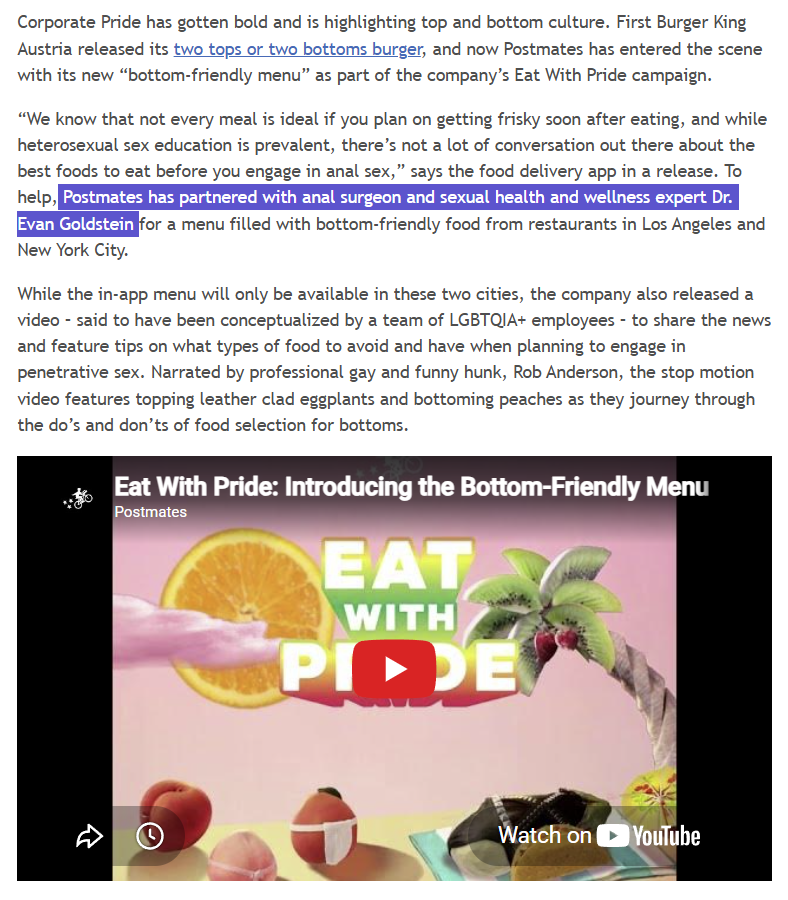
Right. In short, members of the broadly-negative camp don’t see artificial intelligence as having the potential to drive Mankind to extinction, but are concerned about the use of AI, and automation more generally, in ways that will make life worse for most people: surveillance, censorship, a worsening job market, cyberattacks, economic exploitation, the spread of falsehood, etc. This camp leans more politically Left than the broadly-positive camp, but as with that group, one can find members who span much of the Overton Window. People holding broadly-negative views are suspicious of the idea that strong or general artificial intelligence is even theoretically possible, but are also suspicious of AI-related corporations, and are usually suspicious of corporations generally.
I’m not a Leftist, at least by most definitions, though when I was living in Oakland in 2012, a girl with blue hair did call me a “Social Justice Warrior”. Not an “SJW” – that acronym wasn’t in use yet; she used the full term. Still, I’ve toyed with making a list of things that Leftists-slash-Hippies are correct about, and at the top of that list would be this: “It’s the corporations, maaaaaaan…”. Other list items would include “protecting the environment is important”, “mass surveillance is bad”, “beware the Military-Industrial Complex” (to quote Eisenhower), “advertisements are designed to sell products and services by provoking insecurity, fear, and greed”, “the modern post-Industrial Revolution education system has been commandeered to the point that it mainly functions to produce worker-bees for Capitalist bosses: white-collar worker-bees from Universities and blue-collar worker-bees from trade schools”, “knowing about other languages, cultures, religions, countries, etc. is a good thing”, and “men who abandon their families should be held strongly accountable for this, with much higher child-support payments and much stricter enforcement”. Hmm. Perhaps I am a Leftist after all. Then again, probably not.
Right. The broadly-negative camp is a case study in the generational divide between Boomer Conservatives and Millennial Conservatives, within the United States and in the First and Second World more generally. A defining characteristic of Right-Wing thought is support for hierarchies – this doesn’t necessarily mean support for every hierarchy to every extent everywhere, but it does mean subscribing to the idea that inherent differences between people justify differences in life courses and outcomes – for example, differences in wealth, political influence, resource access, gender roles, etc. It also means subscribing to the idea that that existing hierarchies are, to some degree, natural and hence desirable – or, at least, tolerable. Corporations are, of course, inherently hierarchical. This is the case in a first-order sense: a corporation will have a pyramid-like structure in which comparatively-small numbers of people at the top make decisions that must then be followed by comparatively-large numbers of people at the bottom; a corporation is generally not a democracy in which every worker gets an equal vote in how a company is run. In the case of publicly-traded corporations, concentration of stock ownership likewise means that a comparatively small number of people have oligarchical control over corporate management and hence overall company direction – sure, a corporation may be “publicly owned”, but in a country where about 50% of stock ownership is concentrated among the wealthiest 1% of the population, and over 90% of stock ownership is concentrated within the wealthiest 10% – that is, in a country like 2026 America – this “public ownership” looks more private than public, and more hierarchical than open, at least to me. Corporations are also hierarchical in a second-order sense, because network effects, economies of scale, and a wide range of shady dealings have resulted in monopolies or near-monopolies in many sectors. The fact that corporations are themselves hierarchical while also pushing the economy towards hierarchy explains why American conservatives, and particularly Republicans, have been sucking corporate cock for the last hundred and fifty years. In the case of Boomers, the spectre of Communism during the Cold War also encouraged the embrace of corporate capitalism, since, in a Boomer Conservative’s mind, the best way to counter the Godless Communist Menace was to build a Golden Calf in the shape of a dollar sign. This worked well for quite some time, and the Boomer Conservative has fond memories of McCarthyism and the Red Scare, during which corporations (particularly, Hollywood studios, media outlets, and the Alliance of Motion Picture and Television Producers, or AMPTP) collaborated to curbstomp Leftist expression. In particular, companies coordinated to “deplatform” Leftists (long before “deplatforming” was a common term) through speech codes, blacklists of people with supposed Communist affiliations, etc. However, starting in the late 2010s, corporate monopolies in the social media, web-hosting, telecommunications, advertising, media, and financial-services spheres started curbstomping Rightist expression – particularly Nationalist and Ethno-Nationalist expression. Gradually, American Conservatives – particularly, Millennial Conservatives – started to think that, perhaps, continuing a century-and-a-half-long tradition of corporate cock-sucking might not be the best idea. Perhaps, they thought: this is one tradition that the “traditionalist” movement would be well to abandon. Since the broadly-negative camp generally favors restraining corporate power, you won’t find many Boomer Conservatives in it, but you will find younger Conservatives.
In many respects, the Broadly-Positive and Broadly-Negative camps can be encapsulated by different iterations of the “I can’t wait for society to collapse so my ideology can rise from the ashes” meme. This is a variant of the Political Compass meme, which itself aims to put political ideologies on a grid with two axes: Left to Right, and Authoritarian to Libertarian:
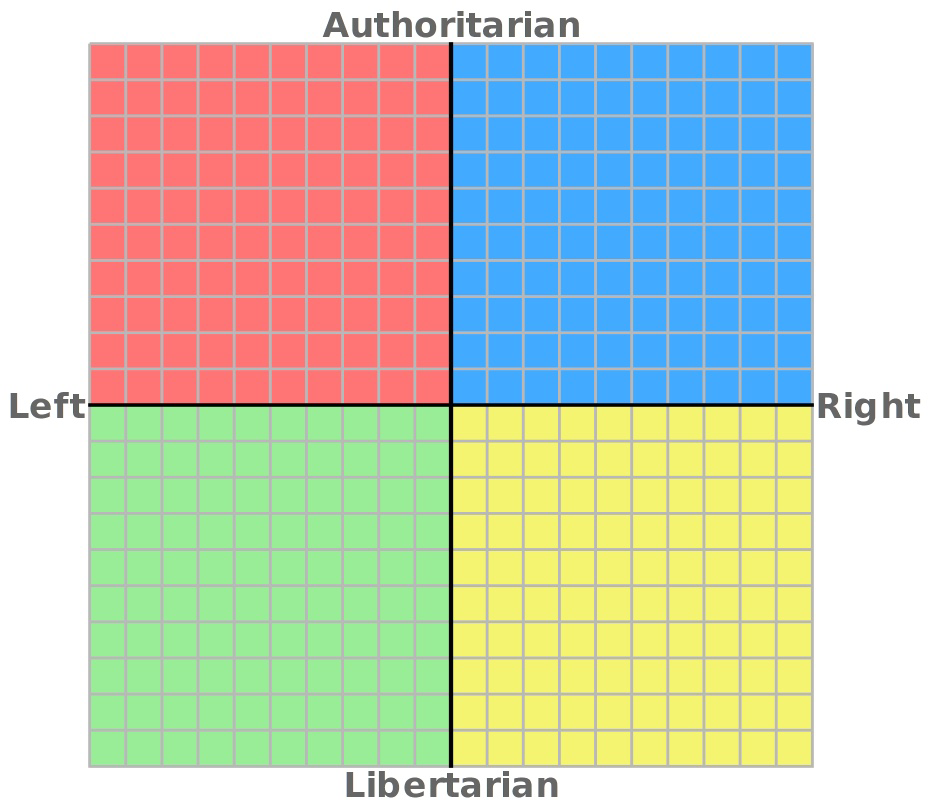
It’s important to note that the Political Compass is merely a model – it isn’t reality, and like all models, it has limitations and breaks down under certain circumstances. In particular, I take issue with the Right-Left axis and its application to NAZBOL, or National Bolshevist, political thought. NAZBOLs are essentially the contrapositive of Libertarians, and combine far-Right social ideology and foreign policy (the “nationalist” part) with far-Left economic ideology (the “Bolshevik” part) – it’s not at all clear, at least to me, where such parties would land on the X-axis of this chart. At least we know where they land on the Y-axis: at the top, maximum authoritarianism.
“Rape: Government-involved” compass meme derivatives
Time-boundedness
“It’s going to get worse before it gets better” vs. “it’s going to get worse, and then worse, and then worse”.
“Intelligence is the ability to achieve goals” – nope; I’m gatekeeping this. AIDS versus gatekeeping.
“Intelligence doesn’t require consciousness” – nope; https://www.youtube.com/watch?v=Qg5QXY_qZuI
“It is better to fail in originality than to succeed in imitation”
-Drawing of “brain” of AI, showing retarded components (“Retardation Locus”, “Token-Wa$ting Gyru$”, “Bad Python Coding Gyrus”, “Over-Promising Hemisphere” & “Under-Delivering Hemisphere” [connected via Dorkus Colossum], “Emoji Over-Use Center”, “Amnesia Lobe”, “Blame-Deflection Cortex”, “Plagarism Gland”, “API-Hammering & CloudFlare-Triggering Center”, “Laziness Lobe”, “Benchmark-Cheating Succulus”, etc.)
https://dana.org/app/uploads/2023/09/anatomy-function-brain-areas-basics-aug-2019-2024.jpeg

THE limits of testing (humanity’s last exam): In order for a test to be objectively and automated-ably gradable, it has to consist of solving problems for which solutions are already known. But, the REAL difficult questions don’t have absolute answers.
The middle path is often the most controversial
https://www.youtube.com/watch?v=Qg5QXY_qZuI&t=672s at 18:00 “they would cooperate really well because they’re effectively the same person” – NO!
“Dead Internet Theory” – no, you just gave internet access to NPCs/
Byzantine general’s problem: an AI to supervise the AI (to avoid conflicting plan execution), but then an AI to supervise that AI, and an AI to supervise that AI, etc.
In any case, beyond the broadly-positive and broadly-negative angles, one also hears predictions that I will call “existentially negative” – these encode the idea that “AI” won’t merely result in harm to the human species, but to our extinction. This is the full-on robot-uprising narrative, and is often associated with the Terminator and Matrix film franchises. That said, I don’t particularly like the phrases “robot uprising” or “terminator scenario” or similar, because in reality, ideas about humanity being threatened or even destroyed by its own intelligent automatons are much older than the Terminator franchise – these ideas much older than robotics, much older than computing, and in fact much older than the English language. These phrases give comparatively-modern works entirely too much primacy, and that isn’t fair – I believe always in giving credit where credit is due, but likewise, I believe in not giving credit where credit is don’t.
Beyond the broadly-positive, broadly-negative, and existentially-negative predictions, there are what I call “nefariously positive” predictions. These aren’t as common, at least on heavily-censored platforms, but I still encounter them. The heart of a “nefariously positive” prediction is this: “AI” will have broadly negative effects on Mankind, and the vast majority of people will end up vastly worse-off by any reasonable metric of wellbeing, but,
Intelligence requires agency (ability to commit a crime)
“Parallelization superintelligence” ==> Limits of parallelization (one woman can have a baby in 9 months, but 9 women can’t work together to have a baby in one month). At some point, you reach a level of not only diminishing returns, but NEGATIVE returns, as systems spend all their time talking to each other and no time actually doing work. “Too big to succeed”.
The “rise” of AI is more the fall of social skills. Auto-catalytic cycle: the less people rely on each other, the better for AI. The real harm of the Internet is reduced human inter-reliance. The story of translating Spanish.
3B. On the topic of translation: “If you don’t know where you’re going, you can’t get there”. This is true of MOST really important problems. Learn a language – you’ll discover that you don’t always agree on translations. For example, translations of the Bible. Have we REALLY solved this problem?
- Papyrus intelligence (“not intelligent” doesn’t mean “not useful” – AI is like Wikipedia, useful, but not intelligent.
- Limits of computation (logic gates)
- Simulation is not reality (Champagne)
- AI cannot compete with art anymore than flowers can, or birdsong can compete with music.
- Companies are bluffing (Issac Arthur – “don’t get in a fight you can’t win…but, actually, even a fairly-matched fight is a pretty bad idea…”)
- Consciousness (specifically, self-awareness) IS required for intelligence, and computers are NOT self-aware. Examples of “multiple-plan-execution” (anaesthesia, aviation examples).
- “We can physically scale computers as much as we want” – nope, due to gravity (black-hole effect) and interdependent calculations (limits to the speed of information transmission)
- Crypto-bros
- Not all Humans are intelligent (a contgroversial take – like the “9/11 compromise” theory or saying “some humans were created by God, while others evolved”). NPCs CAN be replaced by computers. Human-ness versus personhood.
- The human brain does NOT have a limited capacity (language-learning).
- “AI is gonna take over” is shilled by people who have a financial interest in scaring you. This includes Occupation Media which wants your attention, CEOs who want investment and barriers to entry, NGOs who want money to defend against a non-existant and indeed impossible threat, and attention whores of all sorts. Yes, I am better, because I don’t suck corporate (or NGO) cock for money. The solution IS the decommercialization of the Internet (fireworks-on-a-plane example). There is no money in saying “the sky ain’t falling”, because that sort of messaging doesn’t sell umbrellae. Then again, I am not in the business of selling umbrellae – I don’t even like them!
- “Enlisted men are stupid, but devious and bear considerable watching” (US Marines handbook)
- “The same people who sold NFTs and shilled the Metaverse are now trying to convince you that computers can think” (can’t even hotbox in the Metaverse).
- “alexander de tocqueville whom I assume most Americans have read”
MUST:
-Terry A. DaVIS VOICE!!!
-Alex Jones voice
De-skilling and de-strengthening (Americans just don’t like to walk – while at KSL: everyone gaining weight, regardless of where they were from)
“AI committed a crime” – like looking up bad words in a dictionary
AI psychosis and metapsychosis
Source code is free speech (if I want to program a virus, I should have the right – though not to release it). I feel the same way about chemistry and biology, by the way, though not going into that.
AI ain’t intelligent, and if you think it is (or if you can’t tell the difference between real and synthetic media), then YOU might not be intelligent, either
Photography, Susan Sontag, and the ineffable. Speaking multiple languages and recalling a conversation but not the language it was in: there is an “internal language” of pure meaning, ineffable. A photographer can only photograph what is visible, but a painter can paint anything he can imagine. Sure, you can type commands to AI, but not everything can be expressed in language: as with the lover who knows what you want more than you yourself to (the dream to meet this person; the dream to be this person for someone).
+++
From what I’ve seen, computer technology (including AI) is going to reduce military power much more than it increases it.
This may seem counter-intuitive for some, but, trust me, entire batallions of North Korean soldiers on the Ukranian front have been neutralized due to gooning epidemics brought on by their first exposure to Russian porn. Just like the Red Man of the Occident had no exposure to (and no immunity against) the smallpox brought by the Conquistadors, so too the Yellow Man of the Orient has no exposure to (and no immunity against) pornography.
The results, in both cases, are tragic 😭
I feel for the men who are struck down by contagion. I would want to shake the hands of survivors.
Then again…maybe not 😰
Signs of NPCs:
-Failure to consider logistics, etc. (“travel by land from Bangkok to Moscow”)
-Irrational attitude towards risk, and the inability to understand that media is not reality: I am not an NPC; I can watch ten hours of plane crashes and sleep soundly before my flight the next day. NPCs can’t put mind over matter because they ARE all matter, and no mind. https://www.youtube.com/watch?v=mKcwkFdq8B4