Hello, and welcome to Free World Blues. In this recording, I will explain why “artificial intelligence” – that is to say, “computer intelligence” – is impossible: not merely impractical or distant in time, but truly impossible. Even though the technology is fake, the risks are real, from being swindled by slick-talking tech bros who invite you to invest your money into nonsensical projects, to developing “AI psychosis”. This latter term refers to delusional beliefs connected in some way to “AI” systems, most commonly large-language models. These can be delusions about “AI” itself (for example, the mistaken belief that computers can think), or delusions fostered by interacting with “AI” (for example, the mistaken belief that, if you walk off the roof of a building and don’t look down, you will not fall, due to gravity behaving according to Wile E. Coyote physics – apparently, AI systems have been binge-watching pirated episodes of Looney Tunes). Regardless of the category into which they fall, these delusions can lead you to make poor business decisions and/or result in you making a fool of yourself, and my goal is to provide conceptual tools that will help you avoid these sorts of missteps.
Starting in late 2022, and intensifying now into 2026, the year of this recording, I’ve encountered ever-more babble about the ostensible technology of “artificial intelligence”. Note that I will be using this phrase – “artificial intelligence”, or “AI” – even though I strongly object to it, simply in order to make this recording comprehensible. In many respects, my attitude towards the phrase “AI” is similar to Daniel Olson’s attitude towards the phrase “smart contract” in reference to cryptocurrency generally, and in reference to NFTs, or non-fungible tokens, in particular. Olson doesn’t like NFTs, and doesn’t think that “smart contracts” are actually smart or useful or desirable (and I’m sympathetic to his views on this – even though I’m less sympathetic to his political views more generally). Nevertheless, he feels compelled to say “smart contract” anyway so that people understand what he’s talking about, and I feel similarly compelled to say “AI” so that you understand what I’m talking about. Olson describes the phrase “smart contract” as a sort of linguistic coup by NFT promoters – they’ve shilled their preferred term to the point where it’s impossible to avoid using it, even though this term encodes a positivity that is quite unwarranted, and much the same has happened with the term “artificial intelligence”, though it’s been a much slower coup. This isn’t the last of the parallels between NFT hype and artificial intelligence hype I’ll be discussing, by the way – there’s significant overlap both in the ways these technologies are promoted and in terms of the people doing the shilling – more on that later. In fact, the similarities between the cryptocurrency bubble and the artificial intelligence bubble are so striking that, if you don’t know much about the former, I will recommend Olson’s recording “Line Go Up – The Problem With NFTs” as a useful resource. It’s less dumbed-down than your average video about the cryptocurrency space, and if you have generally Democratic-Socialist leanings (and are the kind of person who listens to NPR, or National Public Radio, in the United States), you’ll love Olson’s conclusions as well. Pair that with Grant Sanderson’s recording “But How Does BitCoin Actually Work?” to fill in the mathematical details, and you’ll have at least a very basic, high-level understanding of what’s been going on with cryptocurrency over the last decade.
In terms of the mid-2020s artificial intelligence dialogue, I’ve found it useful to divide commentary into five categories, or “camps”:
1. The Broadly-Positive
The first camp includes those whose attitudes towards artificial intelligence are broadly positive, with claims that AI will provide cures for diseases (finally freeing us from cancer, AIDS, and LIGMA), that AI will generate massive economic growth and material abundance, that AI will solve serious problems like climate change, etc. Members of this camp don’t necessarily deny the potential (or even existing) negative impacts of AI, but tends to claim that these downsides are more than offset by benefits – or, at least, that they will be so-offset in the foreseeable future. Most broadly-positive commentary is grounded in a neoliberal worldview, or at least, in some strain of political materialism. By “political materialism”, I don’t necessarily mean “greed” – there are arguments that political materialism is inherently greedy, and I find many of those arguments rather convincing – but, that is a story for another recording. Rather, “political materialism” is any political philosophy or viewpoint where the amount and/or distribution of “stuff” is considered important. By “stuff”, I mean “things-of-value” – that is, manufactured products, natural resources, casual and professional services, etc. I am using the term “things-of-value” in the way it is used by the American IRS, or Internal Revenue Service: anything which has a potential price in an economy is a “thing-of-value”, and hence subject to taxation. This includes commodities like water and gasoline and rice, products like iPhones and socks, services like electricity and telecommunications and healthcare, and valuable claim-type rights – for example, the right to charge royalties on a patent or trademark, or the right to broadcast on a certain portion of the radio spectrum, or the right to use a certain plot of land for farming or mining or building dwellings, etc. Almost anything can be a thing-of-value under this definition – notably, this includes illegal products and services. For example, if you illegally manufacture drugs, or work as a private-sector hitman (that is, an assassin), then under United States law, you are required to report the fair market value of these products or activities, and pay tax on that amount. You are also required to report (and pay taxes on) things-of-value that, while themselves not illegal, were illegally obtained – for example, if you steal a car, you must pay tax on the market value of that car just as if you had earned the same amount of income in any other way. Political materialists come in many flavors, from Communists to Socialists to Neoliberal Capitalists to Laissez-Faire Capitalists to Anarcho-Capitalists, but are united in that they think the amount and distribution of valuable “stuff” is of great importance. Political Materialists of all flavors are quite easy to identify – they give themselves away because they will never admit that any policy proposal has financially-harmful downsides, even though virtually any policy is going to cause at least some economic disadvantage over at least some timeframe to at least some party. Rather than do the honest thing (which would be to admit that a policy has economically negative effects but argue that these are more than offset by other benefits of the policy), Political Materialists deny the downsides entirely. For example, the American Republican Party will never admit that large-scale deportation of unauthorized immigrants will cause a decline in national Gross Domestic Product (even though it almost certainly will), and the American Democratic Party will never admit that stronger environmental regulations will lower profits for certain polluting industries and result in layoffs (even though they almost certainly will). Non-Materialist political leaders aren’t like this. If a Theocrat declares “we must do X, Y, and Z in order to secure the Grace of God and the Mandate of Heaven” (whatever the Hell that means), he’s not going to be overly concerned with the fact that this will worsen his nation’s trade deficit; if a Fascist declares “We must do X, Y, and Z in order to forge the unity of our Eternally Pure Blood (whatever the Hell that means), he’s not going to be dissuaded by the fact that doing this will hurt stock valuations. People and institutions who hold broadly-positive views of artificial intelligence usually also subscribe to Marxist Historiography. This term is much-misunderstood, but it’s important to note that, when Marx was active in the early- to mid-1800s, he really had two then-radical ideas: the first was Communism (of which he promoted an eponymous form, i.e., Marxism), and the second was that economic factors are a major driving force in history. This is Marxist Historiography, well-encapsulated by the saying “the planting of the first potato in Europe changed more lives than the deeds of a thousand kings”. Marx was a revolutionary in the direct political sense that he fomented Communist revolutions, but also in an academic sense, in that he put economics at the forefront of world events. In 2026, the year of this recording, Marxism and other forms of Communism are controversial (I would argue – in some ways more controversial than they were in the 1800s), but Marxist Historiography is quite mainstream, including (I would argue – in some ways especially) among those who strongly oppose Communism. Members of this camp typically support AI development, and usually think that AI will be easy to steer, or will tend to steer itself, in a political and economic direction they favor – even though different members of the broadly-positive camp will disagree on what direction this is. A Nationalist in the broadly-positive camp might support AI development because he thinks it is likely that his own country’s development of AI will ensure national power, prestige, military dominance, and the like. A Socialist in the broadly-positive camp might support AI development because he thinks it is likely that automation will give rise to great material abundance and then some sort of universal basic income (or UBI), with decreased inequality both within and between nation-states.
2. The Broadly-Negative
The second camp consists of people whose views of artificial intelligence are broadly negative – but, critically, not existentially negative. People in this camp are fond of claiming that AI development will lead to some sort of cyberpunk dystopia. I don’t mean the cool kind of cyberpunk dystopia where you ride your motorcycle through atmospheric, rainy streets under glowing neon signs written in Japanese on your way to meet your girl at a noodle bar and plot the overthrow of the government; I mean the uncool kind of cyberpunk dystopia, where virtually all wealth is controlled by a few massive corporations that charge you money to breathe and hack your NeuraLink to turn you gay during Pride Month because some CEO gets a trillion dollars in stock options for every 0.1% increase in sales of “bottom-friendly burgers”:
AHEM:

AHEM:
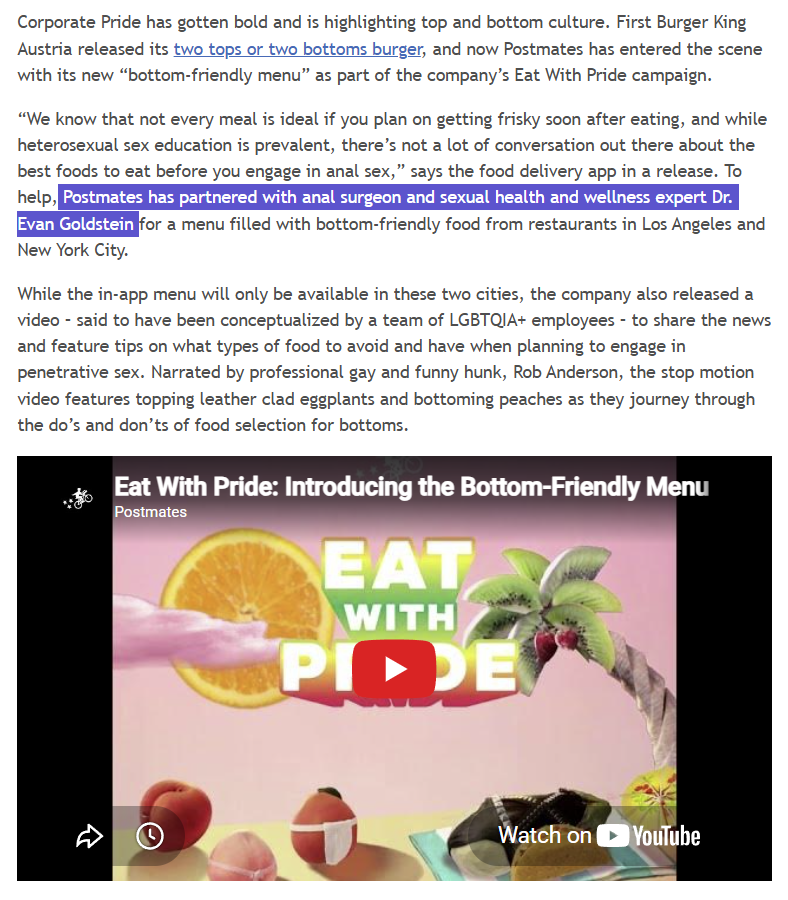
Right. In short, members of the broadly-negative camp don’t see artificial intelligence as having the potential to drive Mankind to extinction, but are concerned about the use of AI, and automation more generally, in ways that will make life worse for most people: surveillance, censorship, a worsening job market, cyberattacks, economic exploitation, the spread of falsehood, etc. This camp leans more politically Left than the broadly-positive camp, but as with that group, one can find members who span much of the Overton Window. People holding broadly-negative views are suspicious of the idea that strong or general artificial intelligence is even theoretically possible, but are also suspicious of AI-related corporations, and are usually suspicious of corporations generally. I’ve toyed with making a list of things that Leftists-slash-Hippies are correct about, and at the top of that list would be this: “It’s the corporations, maaaaaaan…”. The broadly-negative camp is a case study in the generational divide between Boomer Conservatives and Millennial Conservatives, within the United States and in the First and Second World more generally. A defining characteristic of Right-Wing thought is support for hierarchies – this doesn’t necessarily mean support for every hierarchy to every extent everywhere, but it does mean subscribing to the idea that inherent differences between people justify differences in life courses and outcomes – for example, differences in wealth, political influence, resource access, etc. It also means subscribing to the idea that that existing hierarchies are, to some degree, natural and hence desirable -or, at least, tolerable. Corporations are, of course, inherently hierarchical. This is the case internally, in which a corporation will have a pyramid-like structure in which comparatively-small numbers of people at the top make decisions that must then be followed by comparatively-large numbers of people at the bottom; a corporation is not a democracy in which every worker gets an equal vote in how a company is run. In the case of publicly-traded corporations, concentration of stock ownership likewise means that a comparatively small number of people have oligarchical control over corporate management and hence overall company direction – sure, a corporation may be “publicly owned”, but in a country where about 50% of stock ownership is concentrated among the wealthiest 1% of the population, and over 90% of stock ownership is concentrated within the wealthiest 10% – that is, in a country like America in 2026 – this “public ownership” looks pretty hierarchical, at least to me. Corporations are also hierarchical externally, in the sense that network effects, economies of scale, and a wide range of shady dealings has resulted in monopolies or near-monopolies in many sectors. The fact that corporations are themselves hierarchical and also push the economy towards hierarchy explains why American conservatives, and particularly Republicans, have been sucking corporate cock for the last hundred and fifty years. In the case of Boomers, the spectre of Communism during the Cold War also encouraged the embrace of corporate capitalism, since, in a Boomer Conservative’s mind, the best way to counter the Godless Communist Menace was to build a Golden Calf in the shape of a dollar sign. This worked well for quite some time, and the Boomer Conservative has fond memories of McCarthyism and the Red Scare, during which corporations (particularly, Hollywood studios and the Alliance of Motion Picture and Television Producers, or AMPTP) collaborated to curbstomp Leftist expression. In particular, companies coordinated to “deplatform” Leftists (before “deplatforming” was even a common term) through speech codes, blacklists of people with supposed Communist affiliations, etc. However, starting in the late 2010s, corporate monopolies in the social media, web-hosting, telecommunications, advertising, and media spheres started curbstomping Rightist expression – particularly Nationalist and Ethno-Nationalist expression. Gradually, American Conservatives – particularly, Millennial Conservatives – started to think that, perhaps, continuing a century-and-a-half-long tradition of corporate cock-sucking might not be the best idea. Perhaps, they thought: this is one tradition that the “traditionalist” movement would be well to abandon. Since the broadly-negative camp generally favors restraining corporate power, you won’t find many Boomer Conservatives in it, but you will find younger Conservatives.
In many respects,
“It’s going to get worse before it gets better” vs. “it’s going to get worse, and then worse, and then worse”.
“Intelligence is the ability to achieve goals” – nope; I’m gatekeeping this.
“Intelligence doesn’t require consciousness” – nope; https://www.youtube.com/watch?v=Qg5QXY_qZuI
“It is better to fail in originality than to succeed in imitation”
The middle path is often the most controversial
https://www.youtube.com/watch?v=Qg5QXY_qZuI&t=672s at 18:00 “they would cooperate really well because they’re effectively the same person” – NO!
In any case, beyond the broadly-positive and broadly-negative angles, one also hears predictions that I will call “existentially negative” – these encode the idea that “AI” won’t merely result in harm to the human species, but to our extinction. This is the full-on robot-uprising narrative, and is often associated with the Terminator and Matrix film franchises. That said, I don’t particularly like the phrases “robot uprising” or “terminator scenario” or similar, because in reality, ideas about humanity being threatened or even destroyed by its own intelligent automatons are much older than the Terminator franchise – these ideas much older than robotics, much older than computing, and in fact much older than the English language. These phrases give comparatively-modern works entirely too much primacy, and that isn’t fair – I believe always in giving credit where credit is due, but likewise, I believe in not giving credit where credit is don’t.
Beyond the broadly-positive, broadly-negative, and existentially-negative predictions, there are what I call “nefariously positive” predictions. These aren’t as common, at least on heavily-censored platforms, but I still encounter them. The heart of a “nefariously positive” prediction is this: “AI” will have broadly negative effects on Mankind, and the vast majority of people will end up vastly worse-off by any reasonable metric of wellbeing, but,
Intelligence requires agency (ability to commit a crime)
“Parallelization superintelligence” ==> Limits of parallelization (one woman can have a baby in 9 months, but 9 women can’t work together to have a baby in one month). At some point, you reach a level of not only diminishing returns, but NEGATIVE returns, as systems spend all their time talking to each other and no time actually doing work. “Too big to succeed”.
The “rise” of AI is more the fall of social skills. Auto-catalytic cycle: the less people rely on each other, the better for AI. The real harm of the Internet is reduced human inter-reliance. The story of translating Spanish.
3B. On the topic of translation: “If you don’t know where you’re going, you can’t get there”. This is true of MOST really important problems. Learn a language – you’ll discover that you don’t always agree on translations. For example, translations of the Bible.
- Papyrus intelligence (“not intelligent” doesn’t mean “not useful” – AI is like Wikipedia, useful, but not intelligent.
- Limits of computation (logic gates)
- Simulation is not reality (Champagne)
- AI cannot compete with art anymore than flowers can, or birdsong can compete with music.
- Companies are bluffing (Issac Arthur – “don’t get in a fight you can’t win…but, actually, even a fairly-matched fight is a pretty bad idea…”)
- Consciousness (specifically, self-awareness) IS required for intelligence, and computers are NOT self-aware. Examples of “multiple-plan-execution” (anaesthesia, aviation examples).
- “We can physically scale computers as much as we want” – nope, due to gravity (black-hole effect) and interdependent calculations (limits to the speed of information transmission)
- Crypto-bros
- Not all Humans are intelligent (a contgroversial take – like the “9/11 compromise” theory or saying “some humans were created by God, while others evolved”). NPCs CAN be replaced by computers. Human-ness versus personhood.
- The human brain does NOT have a limited capacity (language-learning).
- “AI is gonna take over” is shilled by people who have a financial interest in scaring you. This includes Occupation Media which wants your attention, CEOs who want investment and barriers to entry, NGOs who want money to defend against a non-existant and indeed impossible threat, and attention whores of all sorts. Yes, I am better, because I don’t suck corporate (or NGO) cock for money. The solution IS the decommercialization of the Internet (fireworks-on-a-plane example). There is no money in saying “the sky ain’t falling”, because that sort of messaging doesn’t sell umbrellae. Then again, I am not in the business of selling umbrellae – I don’t even like them!
- “Enlisted men are stupid, but devious and bear considerable watching” (US Marines handbook)
- “The same people who sold NFTs and shilled the Metaverse are now trying to convince you that computers can think” (can’t even hotbox in the Metaverse).
- “alexander de tocqueville whom I assume most Americans have read”
MUST:
-Terry A. DaVIS VOICE!!!
-Alex Jones voice
AI psychosis and metapsychosis
Source code is free speech (if I want to program a virus, I should have the right – though not to release it). I feel the same way about chemistry and biology, by the way, though not going into that.
AI ain’t intelligent, and if you think it is (or if you can’t tell the difference between real and synthetic media), then YOU might not be intelligent, either.