ПРОВЕРКА
I. Introduction:
The further the Cold War fades into history, the more convinced Russians are that it never ended. The détente under Regan and Gorbachev is forgotten. Even the dissolution of the Soviet Union on 1991-12-25 (shortly before my fourth birthday), which was as official an end to the Cold War as could possibly exist, means nothing. Chaucer wrote “As tyme hem hurt, a tyme doth hem cure” – the root of our modern English proverb “time heals all wounds”. Chaucer never traveled to Russia. I wouldn’t recommend Russian healthcare to anyone who can avoid it, incidentally. America has become, for better or worse, a nation of immigrants. As a result, physicians (and I count dentists among them – if you want to make your dentist’s day, call him “doctor”) have seen the work of their foreign counterparts, and are rarely shy about commenting on it on it. An orthodontist sees a man who got braces in Turkey, and forms his opinion of Turkish orthodontic skills. A general surgeon sees an Indian woman’s Cesarean scar, and forms his opinion of Indian obstetrics. Over time, physicians – especially those in large cities – develop a sense of the quality of medical care in the (many) nations whose former nationals find their ways into their offices. They’ll say: “Oh, I wouldn’t get my wisdom teeth out in Bangladesh” or “You know, those Ethiopians really do know how to take care of kidney stones – makes sense; it’s hot there, hard to drink enough water, so I’m sure they see plenty of stones”. I have consistently been warned, by American doctors, to avoid Russian medical care whenever possible. I remember when my girl bore my son in the роддоме (maternity ward, or literally “birth building”) of a Moscow hospital. It was a cold October day, and with tapwater undrinkable, I brought in bottles of water for her, a five-liter plastic canister in each hand, up the unheated elevator and through the frozen hallways. As the elevator creaked upwards, I heard the screams on each floor as clouds of my breath glowed red in the dim light of the floor indicator. Once I reached the floor where I heard only women’s screams, I knew I has arrived. She lived, and my son lived. The woman in the adjacent bed – her daughter wasn’t so lucky, but as for me and for mine, we avoided the worst.
This is a story of something I didn’t avoid – a Проверка (literally a “verification” or “check”, though in truth an interrogation) at Домодедово, a major international airport serving Moscow. This incident occurred from the late night of 2026-01-09 to the early morning hours of 2026-01-10, following my arrival from a short leisure trip to Armenia.
I am well aware that I’ll face personal criticism over the events I describe.
“Russia fans” (for lack of a better phrase – “Russophile” is too politicized) will claim that my experience was far from universal, or that I was harassed by “a few bad apples”, or that the incident was an inevitable result of the Russo-Ukrainian war, or that the actions of America as a nation justify how I was treated, or that I behaved myself improperly. Some, especially those critical of America, the land of my birth, will be gleeful over what I was subjected to, and disappointed only that nothing took a turn for the (even) worse. Many will say that I am making a mountain from a molehill and ought not to be (or have been) frightened in the least, since “this is just the way things are”.
“Russia opponents” (for lack of a better phrase – “Russophobe” is too politicized) will tell me that I got what I deserved, that I was a fool for ever setting foot in Russia, and that I deserve no sympathy for the unpleasantness I experienced (in the same sense that a man who burns himself after lighting fireworks in his mouth is responsible for his own disfigurement). Some, especially those critical of any flow of foreign money into Russia, will declare that every ruble I spent in Russia, every bit of tax paid, makes me a culprit in Russian military aggression, and hence deserving of a far worse fate than I’ve been served. Just as there are insufferable Western Rightists creating video compilations with descriptions like “Feminist OWNED with FACTS and LOGIC – episode 9,843,576”, there are insufferable Western Leftists creating video compilations with descriptions like “British moron fell so deeply into Russian misinformation that he paid £6,000 to actually move to Russia on the government’s new ‘traditional values visa’ – now complaining of high prices, racism, FSB (ФСБ) constantly interrogating, got locked up for 6 hours, and the people keep calling him stupid” – in fact, Irish writer Caolan Robertson, a resident of Ukraine, produced exactly such a video recording (link). It’s somehow fitting that this Irishman, who lives on one side of the Russo-Ukrainian conflict, is criticizing an Englishman who lives on the other side. The troubled Irish-English relationship deeply resembles the troubled Russian-Ukrainian relationship. In both cases, we have a pair of people-groups which are very closely related in every sense: they’re similar in genetics, physical appearance, language, style of dress, cuisine, etc., and are geographically adjacent, yet have a long and bloody history of strife. One can’t reliably tell an Irishman from an Englishman (or a Russian Slav from a Ukrainian Slav) by examining skin color, facial geometry, eye color or shape, or any other physical attribute. If “race”, as anthropologically understood, is necessarily a classification based on something observable and inborn, then the Irish and English are the same race – as are Russians and Ukrainians; as are Indians and Pakistanis. Yet in all three cases, we see “troubles” (to borrow the Anglo-Irish term) that resemble racial tensions: these are intriguing examples of how race-hate can arise between groups of people who are, for all intents and purposes, members of the same “race”. I consider these tensions to be more “racial” than religious or nationalist, because in general, the hatred that each group feels for its ostensible opponent is indelible, in the same sense that race is indelible – this animosity will not be alleviated if the alleged “enemy” changes his faith or citizenship. If a man is born Russian, he will always be hated by Ukrainians, even if he changes his citizenship. If a man is born Irish, he will always be hated by the English, even if he gives up Catholicism and the Gaelic language and his Irish passport. If a man is born Indian, he will always be hated by Pakistanis, even if he converts to Islam and changes his nationality. Just as one cannot “wash away” one’s race in the eye of a racist, it seems that nothing will “wash away” these forms of hatred in the glaring eyes that each group turns upon the other.
II. Reasons & Non-Reasons For My Presence In Russia:
Immigration is a controversial subject, and so I think it sensible to describe the reasons why I moved to Russia, and perhaps more importantly, the “non-reasons”, i.e., considerations that were not a factor in my decision. I do consider myself an immigrant, which likely grates upon the ears of my fellow Americans to some degree. When living and working abroad, Americans generally consider themselves to be ex-patriates (“ex-pats”), never immigrants. A Mexican who travels to America in order to work as an electrician and earn $200,000 per year is an “immigrant” – specifically, an economic migrant. An American who travels to Mexico to teach English for $10,000 per year is an “ex-patriate”: Americans hate to be described as immigrants. Likewise, Americans think it perfectly normal for themselves to have sex with people from other nations, but are surprised when foreigners do the same. To an American, an international liason is mundane if one of the parties is American, but very surprising otherwise. Consider, if you dare, a hypothetical conversation with an average American. If you remark “My father is Indian and my mother is American,” the response might be something like “Ah, I see, I love Indian food – I hope your dad passed down some recipies!”. If you remark “Well, my father is American but my mother is Nepalese,” you’ll hear something like “Ah, that’s very cool – I’ve always wanted to visit Nepal, such a unique culture”. However, if you say “I’m half-Cambodian and half-Lebanese”, your American interlocutor will be flabbergasted: “How did that happen?”, he will exclaim, white with shock. Similarly, just as Americans never like to consider themselves to be “immigrants”, they never like to describe themselves as engaging in subsistance agriculture. To an American, “subsistance farming” is something that is practiced in rural Africa and Southeast Asia. Americans, instead, engage in “smallholding” or “family farming”, and our ancestors who settled the Western United States (my own ancestors among them) were “homesteaders”, notwithstanding the fact that all of these terms mean the same thing: A group of people, usually a nuclear or extended family, living on a fixed plot of land and surviving – “subsisting”, one might say – on what they produce with their own hands. I’m not interested in any of this circumlocution. I’ll call a spade a spade, and myself – an immigrant.
It’s worth noting that I’ve been resident in Russia for twelve years as of the year of this writing (2026), and hence didn’t visit under the “Traditional Values Visa” (which was introduced in September of 2024, i.e., ten years after I set foot in Russia). My right to reside in Russia (such as it is) is also provided by a Вид Hа Жителстово (ВНЖ), (“View Towards Residence” or “Type/Variant/Form of Residence”), which is somewhat akin to an American “Green Card” (Permanent Residence Permit), though with vastly more restrictions. This is distinct from the the Разрешение На Временное Проживание (РВП), or “Permission/Agreement for Temporary Residence” which is awarded to those under the “Traditional Values” visa. An РВП is a “lesser” document with a fixed duration of three years – though other durations are available for РВПО, Разрешение На Временное Проживание в Целях Получения Образования (“Permission For Temporary Residence For The Purposes of Obtaining Education”), which is a document often thought of as a variant of the “normal” РВП. A Вид На Жителство, my document, can be issued for any period longer than six months (defined specifically as 183 days) or can be indefinite, and in practice most are indefinite – indeed, mine is. It was issued not under the umbrella of “traditional values” but because I am supporting a minor biological child who is a Russian citizen, in my case a son born in late 2020. I also speak Russian fluently. Hence, there are many differences between my situation and that of the hapless Angloid man featured in Robertson’s recording. I certainly didn’t move to Russia in 2014 seeking a country with traditional values. Nor was I seeking a “tradwife” – that word didn’t even exist at the time, and indeed TikTok, where much tradwife “influencing” seems to occur, wasn’t even launched until I had been in Russia for two years. Nor was I seeking a traditional religious community, be it Праврославные (“Russian Orthodox”) or otherwise – I am not religious.
Nor was I, or am I, a “passport bro”. That term had been coined three years before I moved to Russia – specifically, it originates from a video entitled “Frustrated” by African-American filmmaker Alan “Al” Greeze, released in 2011. Greeze’s documentary and writing were focused specifically on the challenges that Black American men face in dating in the United States, and on the potential benefits of dating in Brazil. This documentary was, in part, a response to an article by Professor William Jelani Cobb entitled “Blame It On Rio” (“Rio” being the Brazilian city of Rio De Janeiro). Cobb’s article appeared in the September 2006 issue of Essence Magazine, which was founded by Edward Lewis and Clarence Smith as “a lifestyle magazine directed at upscale African-American women”. The original article has been memory-holed (broken link), but the Wayback Machine delivers (link). Referring to himself in the third person, Cobb begins by writing “Assigned by Essence to investigate rumors of U.S. brothers [that means Black men] flocking to Rio de Janeiro for secret sex vacations, our writer found more than he bargained for.” He goes on to promise “a companion story on sisters’ [that means Black women’s] erotic vacations in paradise.” Greeze disliked Cobb’s article, and he especially disliked much of the rhetoric around the article that was spreading on social media – which, at the time, consisted primarily of MySpace, TheFaceBook, and Twitter (the latter of which was less than six months old when the article came out). I am not currently (nor have I ever been) an African American man, and I am not currently (nor have I ever been) resident in Brazil. Saddest of all, I am not currently (nor have I ever been) an “upscale African American woman”, so I fall well outside the target audience of Essence Magazine. As a result, I wasn’t at all familiar with the phenomena of “passport bros” when I moved to Russia in 2014, and I suspect that the majority of White Americans were likewise ignorant. I didn’t understand, and probably will never understand, the dating scene that Greeze encountered as a Black Millennial man growing up in the Bronx, then the poorest area of America:

From my perspective, Greeze’s struggles were simply “somebody else’s problem”, and as is so often the case, it’s very easy to overlook problems that affect other groups of people, which is precisely what I did. I’m not at all proud of this, but this is the reality, and to quote Greeze himself, “reality is the most compelling narrative of all” (link). It wasn’t until I had been living in Russia for many years that the term “passport bro” started to be appropriated and misused by mainstream American society – something that, like ignoring the problems of others, has happened far too often even in the miniscule span of my life. In fact, I’ll be discussing the appropriation and misuse of another term of African-American origin shortly.
Since the term “passport bro” is nowadays constantly misused as a synonym for “international pickup artist” or “sex tourist”, I’ll note that I am neither of these, either. Most criticism of the “pickup artist” community is focused on its alleged misogynistic and/or “right-wing extremist” tendencies, but I dislike pickup artists primarily for a different reason: I find their commentary to be overwhelmingly stupid and annoying. When I was in high school, graduating in 2006, a (now-former) friend of mine, C.R.K.S., fell into deep fascination with the “pickup artist” Erik von Markovik, who calls himself “Mystery” among various other aliases. I prefer his legal name, since Марковик sounds like a diminutive of the Russian noun Марковка, meaning “carrot”, so “Марковик” might be translated from Russian as “little carrot”, with the diminutive also altering the gender from feminine (carrots, Марковки, are feminine) to masculine. There is no more suitably-phallic and suitably-degrading name for a “pickup artist” than “Mister Tiny-Carrot”. My then-friend C.R.K.S. obtained a paper copy of Markovik’s most famous work, “The Mystery Method: How To Put Beautiful Women Under Your Spell: The Venusian Arts Handbook” (yes, the book has two subtitles – or, I suppose, a subtitle and a sub-subtitle). My then-friend read through it dozens of times, leaving the pages well-worn, and loaned it to me for a weekend. I tried reading it, but found the writing insufferable, and returned it to him largely unread. In general, I don’t consider women’s desires to be particularly mysterious, nor do I think that women and men differ much in what they want from a partner. To a first approximation, women (like men) want someone who is sane, sober, responsible, honest, in a good financial position, physically attractive, and healthy, with a personality that is not so aggressive as to make them a tyrant, but not so passive as to make them a push-over. Men and women alike show assortative preferences in dating (as in other domains of life), i.e., people tend to prefer people similar to themselves in terms of religion, political beliefs, race and ethnicity, language, etc. This is a manifestation of in-group bias, whereby every person has a tendency to think that his own religious and political beliefs are the most moral, that the physical characteristics of his own race are the most beautiful, that his language is the most melodic and has been used to write the best literature, etc. This isn’t exactly rocket science, but “pickup artists” want you to think it is, so that they can sell you their books (or, in more recent years, online courses). In addition to being transparently greedy and exploitive of their own followers, “pickup artists” strike me as transparently dishonest. A “pickup artist” clearly has a strong incentive to exaggerate or fabricate stories about his sexual exploits in order boost his ego and to sell more products and services, and as a rule, men who are involved in such things are far more egotistical and money-hungry than average American, which is really saying something. If a man advocates deceiving women, it’s very likely he will also inflate his “credentials” to deceive his male followers. Dishonest people rarely confine their deceitfulness to a single realm – someone who is dishonest in love is typically also dishonest in business, dishonest when filing his taxes, dishonest when telling his doctor how many hot dogs he eats, etc. (link). Furthermore, if my intimate life was so exciting that I spent most of my time partying with supermodels in a hot tub full of champagne on a hundred-million-dollar private yacht that I just purchased, I wouldn’t be spending my time blabbering about my seduction skills to online strangers, nor hitting them up for $39.99 a month for a course entitled “ten card tricks that will cause ANY woman to give you a blowjob”.
To the extent that I do pay attention to certain “pick-up artists”, it is because they are deeply self-contradictory, and I find such people interesting. There is Milo Yiannopoulos, the Gay Catholic Fundamentalist. Then, there is Daryush Valizadeh. He is an ” international pick-up artist”, and the author of a series of self-published books with titles including “Bang Colombia”, “Bang Estonia”, “Bang Iceland”, “Bang Lithuania”, and “Bang Poland”. Are you noticing a pattern here? The United Nations counts 193 countries, and I consider Palestine to be the 194th, so Mr. Valizadeh has a winning formula that will allow him to publish and sell nearly 200 unique books if he keeps on simply prepending the word “Bang” to the name of each nation. How about a book about chasing women in North Korea? That would sell plenty of copies – I’d read thatr. Yet despite being a “pick-up artist” and having written dozens of “bang guides”, Valizadeh is also a member of the Armenian Orthodox Church, and promotes celibacy outside of marriage. He is an anti-immigration activist and is especially opposed to immigration from Islamic countries to the United States, yet his father is an Iranian immigrant. Hence, we have the rare case of an Iranian-American anti-Muslim celibate pick-up artist who complains about facing racial discrimination abroad while peddling it at home: quite the combination. I have read portions of his book “Bang Ukraine” (he hasn’t published “Bang Russia” yet, so this was the closest thing). It contains the following astounding passage:
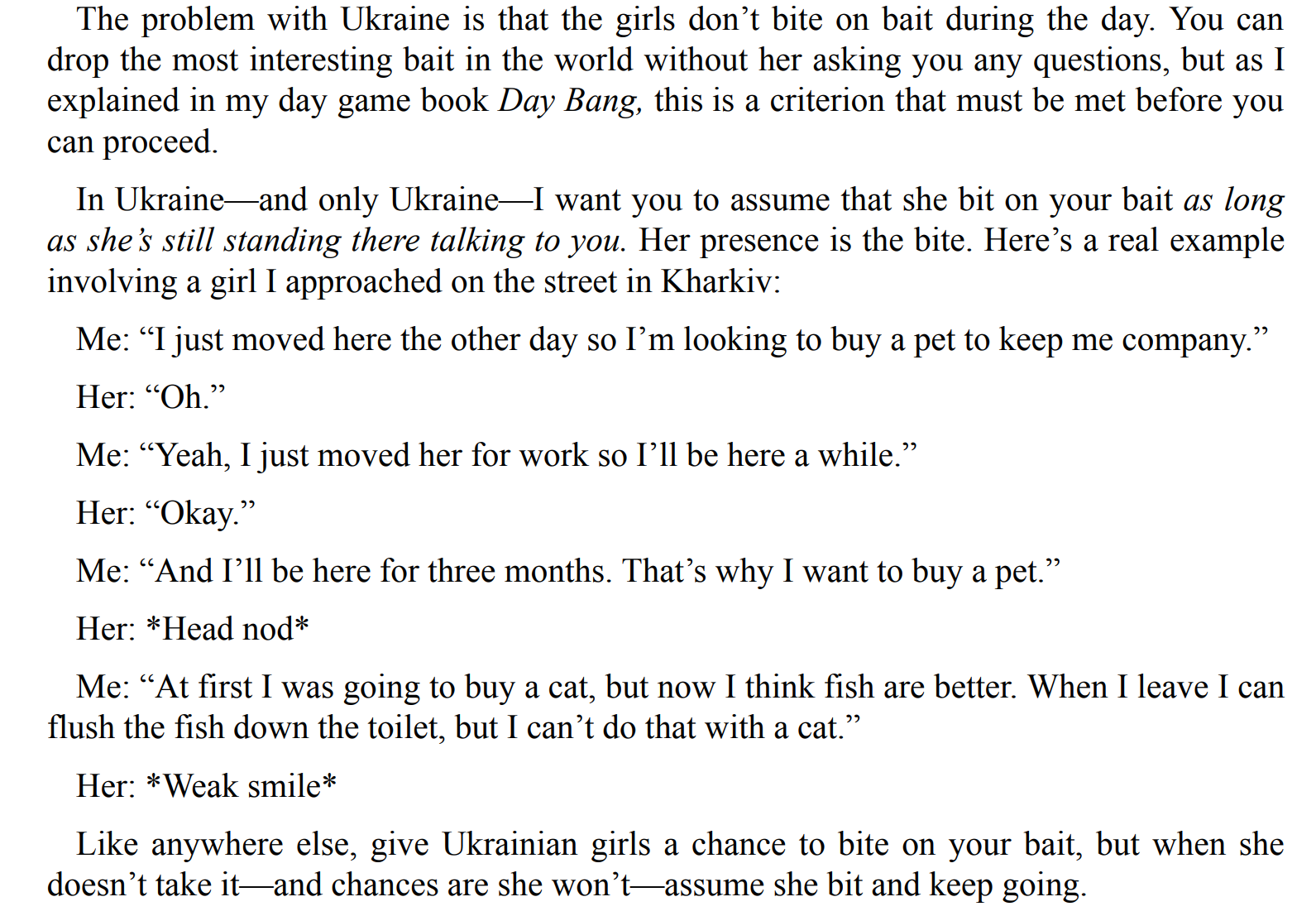
I don’t particularly think that flying to Ukraine, traveling by bus to the industrial city of Харьков (Kharkov), walking up to a random woman who barely speaks English, and telling her that I want to buy a fish from a pet store and then flush it down the toilet is a particularly promising way to improve my romantic prospects. Then again, perhaps I’m speaking out of turn – I’m not a “pickup artist”. This quote does, however, reflect the level of “intellect” that I perceive these sorts of people as having. Incidentally, even if I had considered Valizadeh to be worth taking advice from (a counterfactual), he reported no success in seducing Russians. I pulled the following from a surviving archive of his website, dating from late 2006 (link); the site was scrubbed from the live Internet and memory-holed years ago, but again, the Wayback Machine delivers:

As is so common in the “pickup artist” community, this is an example of an observation framed as specifically related to women and sexuality when the truth is far more general: It is exceedingly difficult to convince any Russian to do anything. This is as true for men as for women, and as true in Почта России (the Russian Post Office) as it is in the bedroom.
A particularly annoying trait common among “pickup artists” (though, sadly, not unique to them) is that they subscribe to the idea of a “dating market”, often evinced by the use of terms like “SMV”, meaning “Sexual Market Value”. Related terms are “hypergamy” (dating or marrying “up”, i.e., finding a partner of higher “SMV”); and “hypogamy”, which is the opposite. There exists a surplus of nonsensical ideas; to paraphrase Benjamin Richard “Yahtzee” Croshaw: If we had to stop the presses every time someone thought up a stupid idea, the presses wouldn’t be running long enough to print a fucking Fortune Cookie. To be truly awful, an idea must have multiple defects: wrongness alone isn’t enough to cross the threshold. The concept of a “dating market” is exceptional in that this idea is at the same time degrading (i.e., it views both men and women as “products” or “services”) and also objectively incorrect. A “market” is, by definition, a forum where goods and/or services can be bought and sold, or bartered and traded. Indeed, buying and selling go together: anything bought by one party is necessarily sold by another party. In a market, one can make a profit by buying low and selling high – or, alternatively, producing something at a lower cost and selling it at a higher cost. In a physical market, if I can grow apples in my orchard for $2 per kilogram and sell them for $3 per kilogram, then I’ll make a profit of $1 on each kilogram I sell. In a more abstract market, if I can buy a share of stock for $100 and sell it the next year for $300, I’ve made a profit of $200, less taxes and trading fees and inflation. Dating doesn’t work like this, fortunately. No woman is thinking: “You know, I met my boyfriend last year, when he was fat and lazy – I got him for cheap, because his Sexual Market Value was low. But, since then, he’s gotten a raise and started working out – now his SMV is higher, and I can sell him for a tidy profit!”. No man is thinking: “Oh dear…I married my wife when she was sober and untattooed, and had a high sexual market value. But, she recently got an ugly tattoo on her face and started drinking a bottle of wine every night – her SMV has plummeted – I’m ruined, it’s 1929 all over again!”. Of course, some people are more attractive than others (physically and otherwise), but differences between entities do not a market make: I would argue that, among the rocky planets, Earth is more beautiful than Mercury, and that, among the gas- and ice-giants, Saturn is more beautiful than Neptune. However, planets cannot be bought or sold (at least currently), and so I wouldn’t consider a “planet market” to exist. Unless one is talking about a literal slave market (and some still exist, mainly in North Africa and parts of the Middle East), the idea of a “dating market” makes no sense, either.
There do exist people who have a slave-market mentality about sexuality, even in the modern era. These are “sex tourists”, who visit prostitutes abroad. The “sex tourist” typically has a love/hate relationship with the “pickup artist” faction, while reserving pure hatred for women and for himself. I’ve always steered clear of prostitution, as it is both morally wrong and an activity for losers. Furthermore, I would consider Russia among the worst countries in the world to be a “sex tourist”. First of all, prostitution is a criminal offense in Russia, and law enforcement in Moscow, where I live, is extremely strict. Conviction rates are on the order of 99.75%, i.e., out of 400 defendants, one would expect that 399 will be convicted and only one will be acquitted (link). This is the result of a system in which judges are employees of the Russian government itself, and the Russian government, like all governments, tends to be its own biggest fan. The State’s greatest fear is of its own citizens, and hence any activity that could discredit the State in the eyes of the People is of grave concern. If you enter Russia and engage in behavior which could lead to headlines – or even whispers – to the effect of “Foreign men are buying our women – why hasn’t the government acted?”, you will be made an example of. If you’re additionally a citizen or national of a country Russia considers to be “unfriendly” (and the United States tops that list), you’ll be made an example of tenfold. Dealing with underworld figures has its own safety concerns, and there exist “patriotic” Russians who are ready to take the law into their own hands when encountering someone who has spit on their Motherland. The fact that “sex tourism” in Russia is a terrible idea doesn’t stop everyone – I lived just off Новом Арбате on Большой Молчановке, central Moscow, in the summer of 2018, when Russia hosted the Fédération Internationale de Football Association (FIFA) World Cup. This is an international competition for football teams (to use the European, and Russian, term), or soccer teams (in American English). Moscow was so flooded with foreign visitors, and short-term rental and hotel prices were so inflated, that I briefly discussed with my then-girlfriend the possibility of moving to her parent’s dacha around 100 kilometers from Moscow for the month-long Games, since this would enable us to rent out my apartment for nearly $700 per night. We ultimately decided against this, due to the logistic considerations and due to the fact that my landlord would likely be perturbed if he caught me subletting my flat. Therefore, we stayed in Moscow, and during the first week of the Games, a brothel opened up nearby to my apartment – arguably, in the same building.
In Russia, buildings are often organized according to the подъезд system. It is difficult to translate подъезд into English; “AI” systems typically render this word as “door” or “entrance”, but I disagree with both of those translations. First of all, a подъезд is specifically a type of exterior door to a building that is intended exclusively or at least primarily for human use. Hence, a car door, while an “external” door and obviously for human use, is not a подъезд, because a car is not a building. Likewise, your bathroom door, while located inside a building, is not a подъезд, because both sides of it are inside some structure; a подъезд must be the first door one passes through when entering a building (and the last door one passes through when exiting). A подъезд must be intended for bidirectional use, and so an emergency fire exit is not a подъезд. Portals that aren’t intended for human use aren’t подъездов either; a cat door is indeed a door, and a hole in your foundation may indeed serve as an entrance for unwanted groundwater, and both are external openings, but neither is a подъезд. I would translate the term as “entrance to a building, where not all sections of that building are accessible from a single exterior door”. Russians typically construct buildings in percisely this way. This isn’t simply a matter of entering a building and being denied access to some section(s) of it through locked internal doors, security guards, or other policies – it is a matter of the actual architecture of the structure. For example, if you visit the emergency room of an American hospital because you sprained your pinky toe, you’re not going to be allowed to walk into an operating room where the surgeons are halfway through an eight-hour liver transplant – but, in principle, you could, if you were authorized to do so: If the operating room is in the same building as the emergency room, then it’s possible, if authorized, to access the operating room through the ER door. The same is true of American apartment buildings: even though you’ll typically only have an exterior key and a key to your own apartment (and perhaps some keys for common spaces, a mailroom, and similar), if you had a set of keys for every door – or were a skilled locksmith – you could access any apartment in the building from any door. Russians do not construct buildings this way; nearly every structure with enough floors to have an elevator will be divided into подъезды, such that each vertical section of the building has its own door for access, and walls prevent the entire space from being accessed from any single door. For example, a ten-story building might have North, South, East, and West подъезды: One to access the ten floors on the North side, one to access the ten floors on the South side, and so-on. This means that, if you are in a room on the first floor of the North подъезда, you can go to the tenth floor of the North section without stepping outside, but if you want to stay on the same first floor but to go the West section, you will need to go outside. As a result, in Russian buildings, it is generally much easier to move between floors (i.e., vertically) than to traverse a given floor (i.e., horizontally). Note also that подъезды are almost always labeled numerically; cardinal directions and other designations are rarely used, at least officially. The system of подъездов has a number of distinct disadvantages: Internal walls decrease the usable floorspace of buildings and reduce options for reconfiguring them, visitors of a building are likely to enter through the wrong подъезд and become lost, and moving between sections of a building is likely to require going outside, which, given the Russian climate, is often very inconvenient. True, moving between подъездами rarely involves being outside for longer than it takes to walk a short distance, typically on the order of ten to one hundred meters. However, as with riding motorcycles, the rule for going outside in the long Russian winter is “all the gear, all the time”. Many fatal accidents have occured when someone underdressed because he was expecting to be outside for only a few minutes, but ended up outside for longer than planned due to navigational errors, defective maps, lost keys, or similar. Therefore, moving between подъездами may require removing one’s outer clothes, putting on thermal underwear, replacing outer clothes, adding snow pants and a scarf, hat, parka, and gloves, etc., only to step outside briefly and then repeat the dressing process in reverse, all to move between two rooms in the same building. One could argue that the system of подъездов improves security by breaking a building into separate chunks, but the same could be accomplished with locking internal doors; all that the approach really does is trade locked internal doors for locked external doors. Fire protection is another potential benefit, but again this is moot due to the possibility of using internal fire doors. Given the myriad disadvantagtes of the подъезд design, and few or any apparent advantages, one might ask: Why do Russians construct buildings this way? The answer is that nobody knows – not even Russians themselves. In this respect, подъезды are similar to the onion domes of Eastern Orthodox churches: I’ve asked many times about why these architectural conventions are so strictly followed, but there is no clear answer. When asked, a Russian is about equally likely to answer “I don’t know” (and leave the matter at that) and to answer “I don’t know” (but launch into open-ended speculation). When the speculation begins, the “answers” considered are generally just mechanisms of kicking the can down the road: “Perhaps onion domes and подъезды are popular in Russia because they were inherited from Mongolian architecture, or Nordic architecture, or Islamic architecture, or Scandinavian architecture,” the Russian muses. This, of course, begs two questions: first, is there evidence that these architectural conventions are or were actually present in those foreign traditions?; second, if Russia did inherit these traditions from foreign cultures, then why did those cultures develop them? Nobody I’ve met has been able to answer either of these questions.
That said, the brothel that opened during the 2018 World Cup was in my building, but associated with a different подъездам; however, its подъезд was extremely close to mine, with the door to my section of the building and the door to the brothel being less than a meter apart – in fact, less than a door’s-width apart. This is unusually close for подъездов. My building was also atypical in that the подъезды divided it more vertically than horizontally – the brothel was underground in the basement, nearly directly below my third-floor apartment. I strongly disliked this development for numerous reasons. First of all, foreigners experiencing difficulty navigating would ask around about the location of the brothel (which had no signage), but found that very few passers-by could speak English, and were hence quite pleased when they encountered me in the evenings on my way home from work. Initially, I begrudgingly led them to the brothel door, and since I was walking in the same direction, I was asked “Ah, are you going there too?” on more than one occasion. Naturally, I found this insulting, since I don’t need to pay to get laid, and I was especially offended to be insulted by someone I had just helped. After a few days of this, I started giving wrong directions. Second of all, foreigners were milling about near my подъезда at all hours of the day and night, and like most Johns, they were unsightly, noisy, and often drunk and disorderly. I saw all nationalities, but Indians and British seemed to be most represented. The only men who never dreampt of bothering Russian women were the Mexicans. This is because, to the extent of my observations, a Mexican man never travels to Russia alone: he is accompanied by his wife, their five children, his aunts and uncles and cousins and nephews and parents and grandparents, etc., and the presence of his entire extended family keeps his behavior in check. Third of all, the prostitutes working in the brothel stepped outside to smoke endless cigarettes, and the ventilation of my building was such that some of this smoke was drawn into my apartment from air intakes nearby. The whole vexing situation lasted only five days – in the early morning hours of Tuesday, June 19th, 2018, I awoke to the sounds of shouting outside, having left my balcony windows open to let in the pleasant air of those warm summer nights. I put on a robe and stepped out onto my balcony, and to the Left, I saw that a group of five OMOH officers were clearing out the brothel, hauling prostitutes and their foreign customers alike into police vans. OMOH is the “Отряд Mобильный Особого Hазначения,” or “Team of Mobile Special-Purpose Officers”. It fills roles similar to American SWAT (Special Weapons And Tactics) teams, but is organized much differently; OMOH teams are highly centralized and controlled by the Russian Federal Government (via the National Guard as an intermediate), as opposed to SWAT teams, which are part of local (that is, sub-National, and in fact even sub-State) police forces. I know nothing of the fates of those prostitutes and their clients, but when ОMOH is involved, the outcomes are certain to be, shall we say – unpleasant.
In addition to not being a “passport bro”, not being a “pickup artist”, and not being a “sex tourist”, I also didn’t move to Russia in search of traditional values. However, there remains some association between Russia and traditionalism in the minds of many Americans, and so I’ll comment briefly on that.
I wouldn’t describe Russia (nor the prеceeding USSR) as a haven, or even a tolerable place, for anyone with traditional values. Over 260 million abortions took place in the Soviet Union, the first nation to legalize the procedure; this is nearly twice the total current population of Russia. Far more Russian lives have been lost to abortion than to the aggression of the Nazis and the genocides of Stalinism, and as for the lives that would be lived but haven’t been due to contraception – one doesn’t even want to think of such things; likely the figures are on the order of 2 billion. If one looks at abortion statistics now, being a child in a Russian woman’s womb has a higher fatality rate than fighting in a penal battalion (of either side) on the front lines of the Russo-Ukrainian war, which is as sobering a thought as any. Anyone who comes to Russia in search of traditional values is a fool. I will speak from experience:
First: In Russia, I constantly meet women who describe themselves as having “traditional values” (“традиционные ценности”) who use contraception, or plan to do so, and don’t want to have a natural number of children – as if the Sexual Revolution was somehow “traditional”. I constantly meet Russians opposed to “ЛГБТ Пропаганда” (“LGBT; i.e., Lesbian, Gay, Bisexual, and Transgender; Propaganda”) who themselves use contraception – not realizing that contraception is itself LGBT, and, specifically, the “T”: It makes women like men (unable to get pregnant), or makes men like women (unable to initiate a pregnancy). Of the many women who proclaim: “a man should be a man, and a woman should be a woman; I love being a woman“, none seem to embrace their natural fertility as a blessing, seeing it instead as a disease to be “treated”. I’ve also met many women who describe themselves as “anti-Feminist” or “not a Feminist” but actively participate in wage labor and manage their own finances. As any good Feminist would tell you (and she, or he, would be right), the Feminist movement is what made it legal for women to engage in these very activities. I imagine that Feminists and Labor Unionists are in similar situations in this regard: they see people spit on Feminism and labor unions, while partaking in the very things (such as women’s ability to own property and vote; such as minimum wages and safety standards on job sites) that Feminists and Labor Unionists fought to secure. It is especially ironic that American men working blue-collar jobs are the most likely of all Americans to support the Republican Party, despite the fact that Republicans are notorious union-busters, and it’s precisely blue-collar workers who do the sort of dangerous jobs – construction, mining, logging, oil drilling, etc. – for which union-won safety protections are most important. Although I don’t support many of the changes brought by more recent waves of Feminism, I strongly believe that men should take an active role in childcare and domestic work, and it’s my opinion that child-support awards in divorce should generally be far higher, and that payment ought to be much more strictly enforced, and so I am, in some sense, a Feminist. Moreover, I am always in favor of truth, and hence I feel sympathy for anyone who fights for change only to be spat upon by people who themselves approve of such changes. No good deed goes unpunished, I suppose. On Monday, March 18th, 2024, I was talking shop with a friend and former colleague; he was managing social media pages for a company that promoted ketamine as an off-label antidepressant. We were commiserating over the fact that his work had become quite difficult following reports that actor Matthew Perry had died due to a ketamine overdose in late 2023. Though my friend’s client hadn’t been directly involved, this was still bad press. In addition to managing concerns about the safety of ketamine as a treatment modality, my friend showed me several posts from a man who incessantly discussed his baby momma’s post-partum depression on the client’s public TheFaceBook page. This fellow had no sense of privacy, and wrote endless, pitifully-sad paragraphs about his girl’s struggles with her newborn daughter. After reading through a bit of this, I remarked: “His girlfriend has post-partum depression, eh? Tell him – You don’t need any wonder-drug; how about you stop living in sin and marry her – that’ll help put her mind at ease. ‘Oh no, my girlfriend just gave birth and she is sad’ – how about you change some diapers and do the dishes? That should help. This ain’t rocket science. I swear – this dude is just looking for a wonder-drug because he doesn’t want to wash the damn dishes. Many such cases – you know how to solve a problem, but you don’t actually want to put in the work to solve it, so you throw your hands up and act like you don’t know what to do, and hold out hope for some magic, technological solution.” Of course, my friend couldn’t write anything of the sort; one can’t tell off prospective customers, no matter how much they might deserve it. I’d make a terrible social media manager.
Second: In Russia, I constantly meet men who are “Православные” (“Russian Orthodox”) but demand sex outside of marriage. This is self-explanatory.
Third: In Russia, I constantly meet “Мусселсаны” (“Muslims”) who drink alcohol. This is also self-explanatory.
Fourth: In Russia, I constantly meet “Еврей” (“Jews”) who eat bacon. Again – self-explanatory.
Fifth: In Russia, I constantly meet people with ostensibly “traditional values” (“традиционные ценности”) who think that a ten-year sentence for marijuana possession is reasonable, notwithstanding the fact that archeological evidence clearly shows recreational marijuana use among Slavic tribes, and notwithstanding the fact that drug criminalization is decidedly not traditional. Criminalization began in the West in 1914 with the Harrison Narcotics Tax Act (which named morphine, heroin, marijuana, and cocaine as “narcotics”, despite only the first two actually being narcotics, setting a precedent for unscientific legislation that persists to this day). The history of Humanity is approximately 170,000 years (that is, by my estimates, if one had a time machine and wished to go back in time and have sex with cavemen or cavewomen and raise healthy children, the furthest one could go back would be about 170,000 years, and probably the best destination would be the area of modern-day Kinshasa, currently a Congolese city a few kilometers inland of the coast of Sub-Saharan West Africa). This means that drug criminalization in its modern, Western form is about 112 years old, i.e., the last 0.07% of human history, and I don’t particularly think that values from the last 0.07% of human history are “traditional” – one might as well say that the morals of five minutes ago are “traditional”.
I have a Russian friend who is a “Z-Патриот” – that is, a vehement supporter of the current СВО (“Специальная Военная Операция” or “Special Military Operation”) in Ukraine. I’ll use the term “Z-Патриот” here, because, in Russia as in America, there are people of varying political beliefs who consider themselves patriotic: to one man, blind support for current government policy is patriotism, whereas to a second, true patriotism means demanding radical Progressive change, and to a third, true patriotism means demanding radical Conservative change. My “Z-Патриот” friend has strongly anti-Western views, chief among them being an ontological belief that Ukraine is a puppet of the United States, with the US being Russia’s true and ultimate enemy, and Americans having created the current conflict by stirring up infighting among Slavs. It therefore makes little sense that he would befriend an American, but relationships – whether of romance or of brotherhood – often defy logic: two people with markedly-similar views might get along well “on paper” (that is, in theory) but hate each other in reality; two people with radically-opposed views might be enemies “on paper” but friends or lovers in reality. We see this in the archetype of the Leftist woman-of-color who is “an activist in the streets, but colonized in the sheets”; we see this in the archetype of the Rightist American Nationalist man who is a cheerleader for mass deportations until his girlfriend is seized and sent back to Panama. On the topic of anti-Western sentiment, my friend is particularly annoyed by the usage of English words (transliterated into Russian). Transliteration is quite common – hence, his anger has many convenient outlets. When we pass a café whose sign reads “Бизнес Ланч” (a transliteration of “Business Lunch”, i.e., a way of writing “Business Lunch” phonetically in Cyrillic), he’ll walk in and harangue the hapless waiters and waitresses about why they’ve used this English phrase, when there is a perfectly good Russian phrase, “Делевой Обедь” (a literal translation of “Business Lunch”).
This sort of behavior is reminiscent of what I saw in America during the Iraq War, or Second Gulf War. Here, I refer to the disastrous American military adventure in Iraq from 2003-2011 launched by then-American President George W. Bush (George Walker Bush) – not to be confused with the disastrous American military adventure in Iraq from 1990-1991 launched by his father, then-American president George H.W. Bush (George Herbert-Walker Bush), which is known retrospectively as the First Gulf War. In any case, I was old enough during the Second Gulf War to remember visiting Red Robin (a terrible chain restaurant) and observing a disgruntled Baby Boomer yell at the waitress because the menu contained the line-item “French Fries”. This fellow demanded that the dish of sliced, deep-fried potatoes be renamed to “Freedom Fries” as a slight against the French, who refused to join George W. Bush’s “Coalition of the Willing” in invading Iraq in search of “weapons of mass destruction”. These WMDs, of course, did not exist, the “evidence” for their existence having been entirely fabricated, in large part by then-Vice President Richard “Dick” Cheney, who, as CEO of the international petroleum company Halliburton, had his eyes on Iraq’s oil reserves. This behavior was fortunately comparatively rare in the Pacific Northwest, where I lived with my family as a high school student. When I observed it, I observed it mainly among men.
When I was working at King Street Labs in the San Francisco tech scene in 2012, a colleague told me that she thought “women were smarter than men”. I corrected her: smart is as smart does, and stupid is as stupid does. That is, a smart person is one who does smart things, and a stupid person is one who does stupid things. Smartness and stupidity are not two extremes along a single spectrum, but rather independent considerations: One can do both (or neither) of smart and stupid things. I told her that I thought men and women were generally equally smart, but unequally stupid: Men and women are about equally likely to do smart things; the real difference is that men are vastly more likely to do stupid things. When one hears about “someone” who bought a used cement mixer, drove it out into a rural field, filled it with explosives, and shot at it with a rifle until it detonated, cratered the ground ten meters deep, sent 300 head of steer flying to their deaths several hundred meters away, and caused millions of dollars of damage as shrapnel from the cement mixer landed on people’s houses and barns, one can bet that the “someone” responsible was a man. Indeed, we know that the “someone” responsible was a man, because he has been apprehended: this incident actually happened.
In short, in my experience, women usually have enough sense to know that yelling at a waiter in a Kirkland restaurant until he agrees to say “Freedom Fries” instead of “French Fries” is not an effective way to change French foreign policy in regards to the invasion of Iraq. Furthermore, women at that time usually had enough sense to recognize that it wasn’t the French who were making a geopolitical blunder – it was ourselves.
Regardless, my Russian “Z-Патриот” friend fights the good fight against Russians who dare to use transliterated English words. On one occasion, we were in Пятёрочкe, a chain supermarket, and the “Голос Пятёрочки” (“Voice of Пятёрочка”), which played endlessly over the loudspeakers, cheerfully advertised “КешБак” (a transliteration of the English phrase “Cash Back”, usually written as one word in Russian, but with intra-word capitalization). He shook his fists in the air: “How can our grandmothers be expected to know what ‘Cash Back’ is?”, he shouted, at no one in particular.
My “Z-Патриот” friend considers himself a bastion of “traditional values”, yet rambles about “Тарелочницах”. This word is a borderline slur, and like many words- and phrases-of-abuse, it’s difficult to translate effectively: one can explain the denotation easily enough, but the connotation is more difficult to convey. This is as true for English as it is for Russian; for example, it’s very difficult to explain the connotation of certain American-origin, anti-African racial slurs to Russians, since fully understanding the connotation requires understanding the brutality of Colonial rule of Africa, of the Middle Passage, of slavery, of the Civil War, of Jim Crow laws and lynchings, etc., and without knowledge of these matters, it’s impossible to appreciate just how hateful such terms are. In practice, that means it’s impossible to convey connotation in any reasonable amount of time in a casual conversation, since a reasonably-full description of the brutality of Americans towards Africans would span many meters of bookshelves. Back to Russian: the root of “Тарелочница” is the word “Тарелка” (meaning “Plate”, specifically, a plate for eating food; there is some overlap with the sense of “Bowl”, a “Глубокая Тарелка” or, literally, a “deep plate”). Then, we have “-ниц-“, a form of feminine diminutive signifier. This diminutive often means “little/small/young thing” or “thing of minor/secondary importance” or “fragment of a greater whole”, though its meaning is extremely context-dependent. For example, adding “-чик” (the masculine equivalent of the feminine diminutive signifier) turns the word “Кузнец” (meaning “Blacksmith”) into the word “Кузнецчик” (meaning “Grasshopper”), and while a grasshopper is certainly physically smaller than a blacksmith, this is hardly an intuitive transformation: it makes sense that a “cigarette” is a “little cigar”, but it makes rather less sense that a “grasshopper” is a “little blacksmith”. I suppose that both are noisy, at least. Finally, in the case of “Тарелочница”, we have the suffix “-a”, a feminine ending which also denotes that this word is a noun, is singular, and is in the nominative case (the nominative case being, in most situations, degenerate with respect to the vocative case in Russian). Note that I am using the term “case” here; British English would typically use the term “declension”. These are not to be confused with conjugations. Overall, a reasonable translation of “Тарелочница” might be “little plate-girl” (with the “little” applying to the size of the girl, not the size of the plate). The fact that Russian is case-marked (unlike modern English) means that there are far fewer opportunities for “wild referents”, i.e., situations in which it’s unclear what part-of-speech a particular word is, which noun an adjective is modifying, which verb an adverb is modifying, or how specific words relate to a prepositional phrase. An example of wild referents in English is “We should discuss filling in the potholes with the City Council members”. It’s unclear if the prepositional phrase “with the City Council members” applies to the verb “filling” (as in, the bodies of the City Council members will be physically used to fill in potholes) or the verb “discuss” (as in, the City Council members will be included in the discussion about filling in potholes). A curious example is “International Women’s Day” – in English, this phrase contains a wild referent; it’s not semantically clear if this is an international (holi)day to celebrate women (i.e., the “day” is international), or if it’s a (holi)day to celebrate international women (i.e., the “women” are international). Of course, the first meaning is the intended one, and in Russian this is:
Международный День Женщин (“International Day of Women”)
But, on occasion, I’ve jokingly called the holiday:
День Международных Женщин (“Day of International Women”)
Typically, I’ve done this to honor a woman I’ve dated, if she is (from my perspective) “international”. Of course, from someone’s perspective, we’re all “international”, no?
We’ve covered denotation. As for the connotation: “Тарелочница” is a term-of-abuse somewhat like “gold-digger”, but whereas a gold-digger is typically thought to have a long-term relationship with the man she seeks to exploit (perhaps marrying and then divorcing him to take half of his assets, or marrying an elderly man and waiting patiently until he dies and leaves her an inheritance), a “Тарелочница” is, stereotypically, a woman who goes on dates with men with the exclusive aim of getting free meals, and is generally thought of as having just one dinner with each man – a sort of serial exploitation. The term “Тарелочница” is also explicitly feminine and hence applies to women only (though one could imagine the masculine equivalent “Тарелочник”). In contrast, the term “gold-digger”, while most commonly applied to women, can also be applied to men, and we see this usage in English as early as the 1800s, with well-documented cases of unscrupulous men marrying women for money and/or to obtain various titles-of-nobility and the associated benefits.
My “Z-Патриот” friend despises and fears Тарелочниц: he’ll say things like “Girls must be skinny, and eat like birds” (this is implying that a girl ought to order a cheap salad rather than an expensive steak at a restaurant; Russians usually use the term “eat like a bird” rather than “eat like a rabbit” to refer to consuming salads, despite the fact that all known species of rabbits are strictly herbivorous, whereas many avians are carnivorous and plenty are ferocious hunters, so this terminology is a mystery to me). I told him: “And, you say you have traditional values? What about traditional standards of female beauty?”, and I brandished my Венерский Палеолит (“Venus Figurine”, or literally “Venus-Carved Rock”) – in my case, it is a plaster-cast copy that I keep in my bag for luck. I purchased it online for about 2,000 рублей (perhaps $25) from a company who sent it in packaging covered with suspiciously Fascist-looking runes, most notably the Sonnenrad (“Sun Wheel” or “Black Sun”); I discarded the packaging posthaste. As a good-luck charm, it hasn’t been working, sadly. Here is the original to my copy:

If anything is “traditional” in Russia, then this figurine must be: it is one of the “Костёнковские Венеры” (“Kostyonki Venus Figurines”) – as strange a term in Russian as it is in English, given that these carvings predate Roman religion (and hence the concept of Venus as a Roman Goddess) by tens of thousands of years. It would be less absurd to call a statue of the mythological figures Romulus and Remus “the George Washington and Thomas Jefferson of Rome”:

After all, these “Founding Fathers” (or more properly “Founding Brothers”) of Rome were purported to live about 2,700 years before the Founding Fathers of America, whereas paleolithic “Venus” figurines predate the first depiction of the Goddess Venus by about 37,000 years: Rome was founded about 14 times closer to the American Revolution than to when these figurines were created.
I explained to my “patriotic” friend that this “Venus” figurine was the definition of traditional values: it was unearthed on Russian territory, on the banks of the Don River near Воронеж (Voronezh), and is on display in Saint Petersburg in the Hermitage Museum, for the Lord’s sake: I’ve been there, and I’ve seen it with my own eyes! “A truly-traditional man doesn’t ask his woman to eat salads like a bird! He feeds her, he feeds her, do you understand? That was what a man did, in traditional times. He braved the cold, he speared that saber-tooth tiger, he hauled the carcass through the blowing snow of the Ice Age, he brought it to his woman, he told her: let’s butcher this saber-tooth tiger together, and cook the meat, and I’ll feed you until you can’t eat another bite, and we’ll lay down on my mammoth pelt, and I’ll take you as my wife, and you’ll never go hungry, and we’ll have the cutest little babies of the Stone Age’ – that’s how it was!”. But, alas, there is no use in talking sense to some people.
I find denial of the fact that traditional values include traditional beauty standards for women (and denial of the fact that these beauty standards emphasize a full figure) particularly irksome in Russia. This is because, while psychological problems related to body image (and, indeed, problems with self-image generally) are pandemic among men and women of all nations, my experience is that Russian women are especially prone to these issues. Russians are far less likely to be overweight than Americans (though perhaps that’s not saying much), but Russian women who are perfectly healthy are nevertheless far more likely than their American counterparts to consider themselves fat, or to obsess over some other perceived cosmetic defect. As I write this, I’m trying to calm my girl after a cheap Chinese scale she ordered on ОЗОН suddenly started reading 15 kilograms higher than it read yesterday, causing her to panic that she had somehow gained this weight overnight. Fortunately, it also reported her body fat as 45% and dry muscle mass as 31%, and I was able to reassure her that this was an error, since a fat-plus-muscle sum of 76% would leave only 24% for water weight, which is roughly the lower limit of what is survivable in people dying of dehydration (clearly not the case with her). I remain on good terms with my ex-wife and the mother of my firstborn son (old habits die hard, especially when the kids are asleep), and recently had to console her during her own body-image crisis. The incident began when she started taking piano lessons. Roughly two months into her lessons, she discovered that she was able to play a certain chord one-handed by stretching the pinky finger and thumb of her left hand (in her case, her dominant hand) to reach the necessary keys. Her instructor, also a rather petite woman, remarked that most people require two hands to play the chord. This led my ex-wife to closely examine her hands and conclude that her left thumb was disproportionately long relative to her other fingers, sending her into such a panic that she began sorting through old photos to delete any in which her left hand appeared. An hour of reassurance dried her tears and saved the family photo albums, but I’ve had experiences like these too often for my taste. There exist vindictive people who see suffering as a competitive sport – more properly, as an entire Olympic Games, with each individual event pitting some group of people against some other. Who is more oppressed, men or women? Men more often work dangerous jobs and die in war; women are more often the victims of domestic violence and die in childbirth. What generation is worse-off, Millennials or Baby Boomers? The Boomers faced the draft of the Vietnam War and are more often victims of age discrimination, but the Millennials face higher unemployment and more expensive housing. Who suffered more, the victims of Stalin or the victims of Hitler? Due to the prevalence of this sort of bickering, many men of my generation are so mean-spirited that they celebrate poor body image among women – perhaps commenting “now, women will feel the pain that we feel when we get swiped left on Grindr, or Tinder” (or whatever). I find myself in the minority as a man who is more interested in courting, marrying, and building families with women than…insulting women on the Internet. If men who claim to have “traditional values” were to actually uphold such values, and uphold these Venus figurines as the traditional standard of feminine beauty, that would do much to improve women’s bodily self-images, which, I believe, is in everyone’s interest. This isn’t to say that there aren’t women (or men) who need to eat more fruits and vegetables, get more exercise, stop smoking and drinking, etc.; it’s merely to say that unrealistic and “narrow” (literally) standards of female appearance result in a large number of women having “комплексы” (that is, “psychological complexes”), and that causes unnecessary suffering for them as well as unnecessary hassle for their husbands and boyfriends, who need to constantly console them – again, a situation I’ve found myself in numerous times. The reality is that everyone has problems, and when you marry someone, their problems become your problems, so alleviating problems that women face will do much to improve men’s lives as well. But, again, there is no use in talking sense to some people.
In reality, the concept of “Традиционные Ценности” (“Traditional Values”) in Russia serves two distinct purposes: one for the State, and one for the People.
“Traditional Values” For The State:
For the Russian State, “we support traditional values” is a convenient rallying cry against the West (and, particularly, Western Europe). It is designed to harness Western discontent over a wide range of issues (mass immigration, ethnic and racial replacement in one’s own homeland, high housing prices, precarious employment, price inflation, epidemic levels of drug abuse, deteriorating mental and physical health, damage to the natural environment, political corruption, deindustrialization, excessive reliance on imported goods, massive disparities in wealth, unsustainable national debt, high crime, crumbling infrastructure, etc.) and direct this anger – much of which I believe is justified anger, though in many cases it’s mistargeted – towards hatred for Western political systems and support for the Russian political system. The State hopes that “logic” along the lines of “the enemy of my enemy is my friend” will turn Westerners’ anger at their own governments towards support for the Russian government, which is, at least in some sense, an “enemy” of the West. Rhetoric about Russia’s “traditional values” conveniently avoids mention of any concrete solutions for the problems that face the West, which is highly beneficial from the standpoint of the State, since Russia doesn’t have (or, at least, hasn’t implemented) many effective concrete solutions, and in fact Russians face the exact same problems as Westerners, broadly speaking. Some problems are less acute in Russia than in the West. Notably, Russia has very little national debt; being debt-free is a surprising benefit of behaving yourself in such a way that nobody – neither foreigners nor your own citizens – will ever agree to loan you money again. Russia has also has far superior public safety, and far less drug abuse, that most Western nations.
One particular moment in my life stands out as an indictment of the severity of the drug crisis in America. In the late afternoon of Monday, August 26th, 2013, I arrived in Black Rock City, Nevada, after a long drive from San Francisco. I had never been there before, and was somewhat apprehensive for numerous reasons, especially related to the driving conditions, which involved operating my vehicle in the unlit, open salt flats in the poor visibility of a dust storm with no marked lanes and with literally tens of thousands of pedestrians milling about. I took great care not to over-drive the visibility (ensuring I could stop within the distance I could see), and nobody was harmed, but it was a white-knuckle experience. I recalled the words of a friend, E.R.S.T., with whom I had ended up at the Fun Collective in Woodinville, Washington, United States in 2004. I was nervous about being at the Fun Collective. “It’s normal to be a little afraid the first time you’re at the Fun Collective”, he had told me.
I am quite a fan of Jolly Ranchers, a type of artificially-flavored, sweet, and somewhat-sour hard candy – in fact, I am such a fan of them that I have difficulty controlling my own consumption, and they’re sour enough that, if I eat several handfuls (which I can hardly stop myself from doing), my tongue and gums will be burned from the malic acid, which leaves me in pain when eating for several days afterwards and surely rattles the teeth of any dentist. Fortunately for my teeth, they are not available in Russia. Even when living in America, I didn’t often buy Jolly Ranchers, but allowed myself to pick up a bag at a gas station convenience store when on a long drive, at most a few times per year. I arrived to Black Rock City with my tongue well-burned and stained, after having consumed the lion’s share of a 14-ounce (nearly 400-gram) bag of these candies during the drive. The next day, on Tuesday, August 27th, 2013, I was riding my bicycle across the salt flats and saw a man in the distance. I decided to ride towards him, to see what he was doing. Once I was within 80 meters, I could hear the sounds of a portable generator, an air compressor, and a pneumatic nail gun. I stopped my bicycle, wary of popping a tire on a discarded nail (I’ve had many flat tires around construction sites), and I dismounted and continued on foot. Once I approached, I saw that he was constructing some sort of stage, probably a half-story tall, by nailing plywood sheeting onto stacks of wooden shipping pallets. We spoke briefly; I won’t relate the nature or content of the conversation. I will relate that my pockets were stuffed with the remainder of my supply of Jolly Ranchers, and in fact I intentionally walked up to him slowly because I had so many in my mouth that it was difficult for me to speak, and I wanted to allow time for them to dissolve. As we spoke and more of the candies dissolved, I absentmindedly reached into my pocket, unwrapped another Jolly Rancher (a cherry one – I had already eaten all of the sour-apple-flavored ones, my favorite), and popped it into my mouth. He noticed this, and looked slightly longingly at me as I placed the empty cellophane square into my right pocket. I had a system for this, you see: I kept my left pocket full of Jolly Ranchers, and then transferred the candies into my mouth and the empty wrappers into my right pocket. Perhaps if my native language was Arabic or Hebrew (or some other right-to-left language), I would have instead used my right pocket for the whole candies and my left pocket for the wrappers. In any case, seeing his acquisitive glance, I took a handful of Jolly Ranchers from my left pocket and offered him one. He set his nail gun down on a pallet and took a cherry one.
“Oh, thanks,” he said, accepting it but not yet unwrapping or consuming it.
“For sure, for sure,” I replied.
“And, uh – is it plain?,” he asked, somewhat cautiously.
I knew immediately what he meant: he thought that the Jolly Rancher might have contained some (presumably high-potency) drug, such as Lysergic Acid Diethylamide (LSD), or, more dangerously, a high-strength narcotic such as Fentanyl.
“Yes, yeah, it’s plain. Just a Jolly Rancher. I only have cherry and grape left. You can have some more, if you like,” I told him.
“Oh, I’ll just take the cherry,” he said, and thanked me. He opened the Jolly Rancher, popped it into his mouth, and I walked back to my bicycle and rode on.
Even in 2013, the drug problem in America was severe enough that a man being offered a Jolly Rancher candy felt the need to ask if it was “plain” – and I was formally dressed and hardly looked like the sort of person likely to be distributing illicit drugs. In the decade since, the situation has only worsened, but fortunately, in Russia, one does not see the streets of “zombified” addicts in the sense that one does in America. When I worked in San Francisco, my photographic lab was at one corner of an intersection in the Tenderloin; the other three corners of the intersection consisted of a Methadone distribution center, a Veteran’s Affairs mental hospital, and a child support enforcement office, so I saw my share of shady characters.
Other problems are more acute in Russia than in the West. Notably, Russians suffer generally worse mental health than Westerners, as evinced by high suicide rates, and fertility rates among Slavic Russians are significantly lower than among White Americans. Efforts to boost fertility rates with various forms of welfare – mainly cash payments to mothers and discounts on mortgage rates for families – have had no more than a negligible effect in Russia, and fail in the Motherland just as they’ve failed everywhere else they’ve been tried, from Western Europe to Asia to South America. The Russian State is currently piloting another “solution” to the demographic crisis: classes for preschoolers on how to be a well-behaved child, in the hopes that such classes will actually improve children’s behavior, which will then encourage parents to have additional children. This strategy will of course also fail, but it is at least novel, and I respect an idea which is bad but at least innovative more than an idea which is bad and also plagiarized. These considerations are all minutæ: in broad terms, the problems facing Eastern Europeans, Western Europeans, East Asians, North Americans, and South Americans are extremely similar. I’ve seen the frigid “Rust Belt” ghost towns left behind by the collapse of the Soviet Union, and they are blighted in exactly the same way as the Rust Belt towns of America, themselves devastated by the collapse of the United States steel industry. A true return to traditional values requires transforming society, but the Russian State lacks the will to do so. The State has banned Gay Pride parades in Red Square and rants endlessly about “the International Gay-Transgender Extremist Movement”; it also recently added the “Childfree Movement” to its list of extremist organizations whose members, and supporters are subject to severe punishment. Yet, Russia hasn’t made any moves towards ending contraception or abortion; if I were in charge and wanted to implement traditional values, I would prohibit both under the strictest regime in human history. The Gays would be a lower priority; let them march in Red Square if they like; I wouldn’t give a damn. Bring the fertility rate up to eight or twelve, to natural levels – that will do far more to transform society than locking someone up for waving a rainbow flag. The Russian state not only fails to uphold “traditional values”, but actively opposes them – at least, if by “traditional values” one means “societal structures, social norms, laws, demographics, economic systems, etc. associated with the past” (and, if “tradition” isn’t a reference to the past, then I must ask: what is it a reference to, exactly?). For example, closed-circuit television (CCTV) cameras – that is, “security cameras” often installed in public for the purpose of mass surveillance – are nearly a century old as of this writing. They were invented in 1927, and in fact by a Russian, Лев Термен (that is, Leonid “Lev” Theremin). He is most famous in both Russia and in the West for inventing the eponymous musical instrument, but Theremin’s most geopolitically-adventurous invention may have been the Эндовибратор (“Endo-Vibrator” or “Internal Oscillator”; known to Americans as “The Thing”), a passive-electronic audio listening bug concealed inside a “gift” given to William Harriman, United States Ambassador to the Soviet Union, in 1945. Moscow was free of security cameras in 1927, and now, 99 years later, it’s bristling with them, with more appearing every day, so the Russian State is certainly not enthusiastic about the tradition of “not constantly performing warrantless video surveillance on its own citizens”. The same, of course, could be said of American “conservatives”, who don’t seem to be interested in conserving the foundational values, norms, or laws of America as they existed in 1776, but that is a separate discussion. The overarching situation is that Russians are governed by a State that advocates for vague “traditional values” while failing to do anything in its power to advance such values in any meaningful way, and in fact, using much of its might to explicitly oppose traditionalism.
That is the State; what about the People? For individual Russians, “traditional values” serve as a means by which men and women bludgeon each other.
“Traditional Values” For Men:
As a rule, a Russian man who professes “traditional values” isn’t ready to wait until marriage (or even the second date) to take a woman to bed, and he certainly isn’t willing to support his woman financially so that she can focus on motherhood and domestic duties. His “traditional values” mean: wash my dishes, cook me something, suck my cock, and loan me a few hundred thousand rubles. I’ll spend half on “skins” (aesthetic digital “collectibles” in online games) and gamble the rest away in a cryptocurrency casino. Also, get me a bottle of vodka, and if I beat you, tell everyone that you got that black eye from falling off a chair while you were changing a lightbulb – I don’t want any trouble with the police. Especially concerning is that a share of Russian men with “traditional values” have a tendency to trivialize rape, which is rather curious considering that rape was nearly-universally punished by death across wide swaths of time and a wide range of civilizations until the liberalization of punishment for this crime (among others) in the 19th and 20th centuries Anno Domini. In this ugly respect, Russian men with ostensibly “traditional values” resemble the fake “Conservative” leaders of America. We Americans have Donald Trump, the self-proclaimed defender of strong morals, who commented about “grabbing women by the pussy”, was a close friend of Jeffrey Epstein, and is actively suppressing and censoring documents related to the Epstein case in a manner that I find exceedingly suspicious. Of course, many American Rightists (myself included) have seen through the charades of the Republican Party in general, and of Donald Trump in particular, for decades. An “art conservator” wants to restore the Mona Lisa such that it (she?) appears exactly as on the day DaVinci finished the painting. A “forest conservationist” wants to restore the forests to their original state, before humans started messing with them, chopping down thousand-year-old trees and setting fire to the rest with gender-reveal-party fireworks. American Rightists hunger for a true Conservative movement, one that will fight for an America that resembles the America the Founding Fathers created, but the Republican Party is clearly not interested in this. The typical Republican politician who claims he wants to “restore America” has no idea what America was like in the 1700s; he is about as effective as an environmentalist who claims he wants to “restore the forests” but doesn’t know what a “tree” is. The modern Republican Party describes itself as “anti-woke”, and is attempting to turn the word “woke” into a political slur against Progressives. The concept of being “woke” originates from African-American Vernacular English, as a variant of the word “awake”, and was used in the early 1900s to signify the importance of awareness, knowledge, and appropriate caution for African people navigating the Jim Crow era. A true Conservative recognizes that Conservatism extends to linguistics, and if we understand the word “woke” in its original sense, we understand that being “anti-woke” means embracing ignorance – that is, being “asleep” to the present and historical realities of America. Hence, the recruiting slogan of the Republican Party in the Trump Era is effectively: “Join the Republicans – we are idiots (and also, our leader thinks that rape is cool)”. This isn’t a particularly alluring sales pitch. Accordingly, it’s no surprise that American Rightists were enthusiastic about the emergence of Nick Fuentes and his “America First” party – until Fuentes started chanting “your body, my choice” and selling quarter-zip sweaters emblazoned with “USA” which were clearly designed to resemble Jeffrey Epstein’s infamous monogrammed “J.E.E.” (Jeffrey Edward Epstein) sweater:

The resemblance is uncanny and clearly not accidental; at left we have Epstein (I censored an image of a woman in the background) and at right we have Fuentes’ merchandise:

Mr. Fuentes has also gone on record stating that “having sex with women is gay”. Hence, America First’s pitch might be seen as: “We’re an alternative to the Republican Party, which is full of idiots who think rape is cool. However, we are also idiots, and also think rape is cool”. Is it too much for an American Conservative to ask for a political party that embodies the foundational values of America and isn’t full of idiots and rapists? I’m not asking for a friend.
“Traditional Values” For Women:
That’s the state of “traditional values” among men. What about the fairer sex? As a rule, a Russian woman who professes “traditional values” isn’t willing to focus her life on motherhood, homeschool her children, or have a natural number of children (the concept of “natural fertility”, i.e., the number of children born if no effort is made to limit fertility artificially, is completely alien to Russian women and must be explained each time the term is used, despite this concept being central to demography and anthropology – it has a Wikipedia article, for the Lord’s sake!). The typical Russian woman lives such an artificial life, and considers this so “normal”, that the very concept of naturalness is to her unimaginable. Her understanding of tradition will rarely cover any more than one-tenth of one percent of the 170,000-year history of humanity. Her concept of what is “typical” is based on a sampling of a miniscule share of all people who have ever lived, and hence she is guilty of what Randall Munroe famously called “the mother of all sampling biases”. Explaining traditional values to Russian women is an exercise in frustration, futility, and above all else, repetition; it’s not my Russian which is the limiting factor, but rather, women’s utter ignorance of the overwhelming majority of cultures that have existed for the overwhelming majority of the time that Homo Sapiens have populated Earth. I’ve tried referencing specific events (“By having ‘traditional values’, I mean, I reject the values of the Sexual Revolution / Industrial Revolution / French Revolution / Enlightenment / etc.”) and I’ve tried referencing specific dates (“By ‘traditional values’, I mean, values that were popular in America in the year 1776 / in Europe in the year 1500 / etc.”), but without exception as of the date of this writing, no woman has any idea of the cultural changes brought by these events (changes that I generally oppose), nor any idea about what life for the average person was like in any year that predates the Internet. Discussions about economic systems are likewise fruitless: despite being residents of the successor-state to the first nation to be founded on the principles of Marxism, Russian women have no understanding of the meanings of Capitalism, Corporatism, Wage Labor, Financialization, Corporate Personhood, or similar (and, if they understand these terms at all, they tend to conflate them). In all fairness to women (and in all fairness to Russians), I consider it possible and in fact likely that a Russian man (or an American man, or an American woman) would be likewise clueless if you spoke of having “the values of 1776 America” or “pre-Industrial Revolution values” or “favoring subsistence agriculture over wage labor” or “opposing corporate personhood” or similar.
Even worse, Russian women who profess to hold “traditional values” are frequently outraged at me when I disclose that I actually have traditional values, and in particular, that I will have a natural number of children. On many occasions, they’ve told me that they hope I get deported from Russia, or threatened to report me for “extremism” (apparently, rejecting contraception and embracing natural fertility makes me some sort of “Right-Wing Extremist”). I usually answer by mentioning that I have many Leftist values: for example, I am a committed Abolitionist and support legislation against slavery, including Louis X’s Ordonnance Royale Du Juillet and the Thirteenth Amendment to the United States Constitution. These laws criminalized slavery in (Continental) France and America in 1315 and 1865 respectively, and I hardly think of Abolitionism as being congruent with the “Far-Right”, but explaining my position on slavery rarely results in anything other than blank stares. Curiously, I’ve met women who claim to have “traditional values”, yet support slavery, despite the fact that slavery is extremely recent, being unknown or at least vanishingly rare before the Agricultural Revolution and the dawn of the Neolithic Period – that is to say, slavery in its commonly-understood form did not exist in any widespread or institutionalized sense for at least the first 90% of human history. The support for slavery I’ve encountered is more than abstract: Russian women who endorse the Peculiar Institution usually have specific ideas about what race(s) of people they want to enslave (often Southeast Asians), and what tasks they want their slaves to do (often construction, farming, gardening, and domestic tasks). Yet even women who unironically advocate for chattel slavery do their best to threaten me with deportation for wanting a natural family.
This is particularly ugly because, in meeting with any woman for the prospects of courtship, I start off by disclosing that I am divorced and have a son living in Russia, and so threats of deportation are inherently threats of family separation. When studying Chemistry at Stanford, during the latter part of my Junior year and the early part of my Senior year, I dated a young Mexican woman who was in America illegally. We met at a Cinco De Mayo party, on Tuesday, May 5th, 2009. During my Junior and Senior years, I lived off-campus and was in the habit of partying with my landlord. This is, of course, rather unusual, especially since these were the sort of parties where most people (including my landlord and including myself) partook of alcohol and various other drugs, especially amphetamines: possessing, consuming, and being under the influence of illegal drugs is typically a strongly undesirable trait in a tenant, but my landlord didn’t seem to mind; in truth, he was much more of a party animal than I was. I was in my early twenties; he was in his late forties, but tall, strong, and strikingly handsome; his girlfriend was my age, and stunningly beautiful. He worked as a UPS (United Parcel Service) deliveryman. UPS is a private company, and competes with other private delivery companies, notably FedEx, or Federal Express, which despite its name has no association with the US Federal Government. More importantly, however, UPS competes with the USPS (United States Postal Service), which is a United States government monopoly. In particular, the USPS’ monopoly status allows it to place parcels into mailboxes, which the UPS is not allowed to do, and this incensed my landlord to no end. He believed that his company wasn’t competing on an even playing field with the USPS, which was of course true, and this cultivated within him a burning hatred for the United States Postal Service, something that he brought up frequently in conversation. There are many branches of the American government that attract disparagement: the President, Congress, and the House of Representatives are obvious targets, given their overtly partisan nature. The Supreme Court, which is de jure non-partisan but de facto partisan, is another target. Many American pacifists hate the American military. Many American taxpayers hate the IRS (Internal Revenue Service, i.e., tax collection service). Americans who care about privacy hate the many spy agencies of our country (including the NSA, or National Security Agency; the FBI, or Federal Bureau of Investigation; and the CIA, or Central Intelligence Agency). Rightists, especially those who favor free markets, despise the Federal Reserve and the SEC (Securities & Exchange Commission). Leftists, especially those concerned about law enforcement overreach, despise police departments and ICE (Immigration and Customs Enforcement). Compared to these, the United States Postal Service is rarely controversial, but in my landlord’s eyes, the greatest Враг Народа, or “Enemy Of The People”, was the Post Office. Notwithstanding any financial harm the USPS may have caused him, in the 1980s, his UPS salary had allowed him to afford down-payments on a half-dozen houses in Palo Alto (something that wouldn’t have been possible in the 2000s, when I met him, and is completely unthinkable in 2026, the year of this writing). He rented the houses out room-by-room, with rental income covering the mortgage payments and property taxes, and he was doing quite well for himself by 2009, though he did still work for UPS. It was in one of these rooms that I lived during my last two years at University. At the Cinco De Mayo party, he and I were passing a bottle of tequila, drinking directly from it in turns, and he went on a drunken tirade about how much lower the USPS’ employee standards were than those of the UPS. He was in shorts, and flexed his calves (which were impressive – he certainly hadn’t skipped leg day) while remarking about a recent study which showed that 68% of USPS workers were clinically obese. Out of the corner of my eye, I saw a beautiful Mexican girl, and decided that I should pause this discussion with my landlord and talk with her. We got along well, and in an hour we were sitting together on a couch, her on my lap, a few sips of tequila, a few kisses. We spoke in English; hers was perfect, effectively native, and I spoke no Spanish, though she did speak Spanish with her friends, many of whose English was less than fluent.
“We should get some weed”, she suggested.
“Do you have a card?”, I asked her. I was referring to a medical marijuana prescription, typically called a “weed card”. California legalized cannabis for ostensibly “medical use” in 1996. In practice, physicians would write prescriptions freely for the vaguest of complaints; in 2011 I obtained a “weed card” for treatment of insomnia after briefly mentioning occasional trouble sleeping. Full legalization for recreational use only occurred in 2016. As a result, when I met this young women in 2009, a prescription was still needed to buy weed, and I didn’t have one yet, so I was asking her if she had one.
She slapped me in the face. “That is private! That is none of your business!”, she shouted. Her hand was closed, but the strike was strong enough that I tasted blood. I did instinctively put my fingers in my mouth and then draw them out again, and there was no visible blood, so I wasn’t bleeding much, and in any case, wounds to the mouth typically heal quickly.
What followed was a flurry of conversation between her and her friends, all in Spanish. Most of them had frightened looks, but some of them were glaring – at me, at her, at both of us? I couldn’t tell; she was still sitting on my lap, after all, so our faces were close enough that it wasn’t easy to determine who was on the receiving end of a stern look. Within a few seconds, the matter was cleared up. When I had asked her if she had a “card”, she thought I meant a “green card” (or Permanent Residence Card), i.e., she thought I was asking her if she had the legal right to reside in the United States. She apologized for the slap; I apologized for the miscommunication; we made up and out, exchanged phone numbers, and started dating. During our relationship, I learned that she was in fact not in the United States legally. This didn’t mean much to me; I was accustomed to illegal immigrants from South America at the time, having had them as colleagues, roommates, fellow students, etc., and immigration enforcement in California in 2009-2010 was as weak as marijuana enforcement. Yes, it was technically illegal to consume marijuana without a prescription, and yes, it was technically illegal to be in California without a valid visa, green card, or American citizenship. In practice, however, law enforcement completely ignored all but the most serious violations: unless you were growing marijuana by the metric ton in thousand-acre fields, or bringing illegal immigrants across the Southern border by the thousands in container trucks, the chances of being prosecuted were negligible. Other than being in America illegally, she was law-abiding, employed, paid her taxes, and was generally a kind and responsible person. At the time, such people had little to fear, at least in California. Her illegal presence in the United States didn’t worry me: could she have been deported? Certainly – and I wouldn’t want that. Then again, could I step out of my front door and be struck dead by lighting? Certainly – and I wouldn’t want that, either. I didn’t think much about either risk, given the extremely remote chances involved. Beyond that, we were young – one doesn’t think so much about risk when one is young. We broke up in 2010, after a bit more than a year together. As with most breakups, there were tears and accusations and a bit of shouting and foul language on both sides; I felt some degree of anger, shame, and disappointment, as did she. This shouldn’t be surprising: breakups rarely happen when all is well in a relationship. Yet as upset as I was at the time, I never wished deportation upon her, and I certainly never threatened her. I didn’t say anything along the lines of: “Well, I don’t agree with you about such-and-such. I’m going to report you to ICE (Immigration and Customs Enforcement), and hopefully they’ll blast open your front door in the middle of the night with no warrant, handcuff you, throw you in a van with tinted windows, and dump your ass back in Mexico, so that you’ll never see your relatives in this country again, HA HA HA!”. As angry as I was at her – and I was angry – doing or saying something so vindictive did not ever, and would not ever, cross my mind. For all my many faults, I am just not like that. Russian women, however, are like that.
A particular traditional value that Russian women desire in men is honesty. I am, of course, all for this: honesty is important in men, in women, in institutions and companies and governments, etc. It simply isn’t practical to check every word that is ever said or written and fine or imprison or execute everyone who acts dishonestly. I don’t demand “absolute” honesty – if the Schutzstaffel asks if you’re hiding any Jews in your attic, and you are, then lying is not only morally acceptable but in fact morally required. Most cases of acceptable dishonesty are less dramatic: if your friend tells you about a musician he adores and whose concert he wants to attend (and would love to attend with you), but you don’t particularly like the music in question, I see no meaningful harm in replying “Ah, I love his music too – yes, let’s go“. These are examples of benevolent, or at least charitable, dishonesty: in neither case is the liar attempting to gain anything personally. The dishonesty that concerns Russian women isn’t of this sort; it’s of the abusive, dangerous, and even deadly sort. There is a joke in Russia: A twenty-year old woman will meet a man, learn that he lives with his parents, and think “How disappointing – I really need a man who can afford his own place“. A thirty-year old woman will meet a man, learn that he lives with his parents, and think “Well, at least he doesn’t live with his wife“. In the decade-long interval between the ages of twenty and thirty, a Russian woman will have experiences with dishonest men that leave her permanently jaded with regards to our sex – and understandably so. Yet Russian women themselves rarely, if ever, practice honesty in regards to relationships. I can’t count the number of times I’ve had conversations along the lines of:
“My top priority in life is having a natural number of children. What about yours?”
“Yes, children are also my top priority.”
“What if a doctor told you that you might die if you got pregnant? What if we were poor and hungry? What if we had one child, and the government made it illegal to have more, like the Chinese Communist Party in 1979?”
“Well, then, I wouldn’t want to get pregnant. I don’t want to die, I don’t want to stave, and I don’t want to go to prison”.
No Russian woman seems willing to answer honestly when asked what her top priority is. She will always ignore the fact that, if a priority is a top priority, then by definition there are no other priorities above it – if a given priority is outranked by other considerations, it is definitively not one’s top priority. That is, after all, what the word “top” means: nothing above. I’ve tried explaining this explicitly, and giving various examples, such as: “Imagine a mountain. The top of the mountain is the point that is higher than all others. If you are on a particular part of a mountain, and there is another part of the mountain that is higher, you are not on top of that mountain”. However, no amount of explanation and no analogy will ever result in a Russian woman replying honestly when asked about her top priority, top goal, top imperative, or similar. In Russia, a woman’s “traditional values” mean: Pay for dinner, buy me a thousand-dollar purse, pay off my debts, pay for my rent and education, smile while doing it, and don’t expect me to lift a finger – I demand honesty from thee, but don’t expect it from me.
I write, of course, “as a general rule” when I describe the Russian men and women who profess “traditional values”. That said, in twelve years, I haven’t encountered a single exception to this “general rule” among either sex (may I encounter one soon, Inshallah!). The problem is not imperfection (nobody is perfect; least of all myself). Rather, it is a complete lack of intention or effort to live according to the values one professes. There are, for example, Muslims in the world who struggle with alcoholism (as are there many people of all faiths, and of none, who struggle with addiction to a wide variety of drugs). I don’t fault the Muslim who struggles with all his might to stop drinking but sometimes slips; I do fault the self-identified “Muslim” who professes faith in Islam but makes no effort to live according to the tenants in his religion. Mistakes and moral failings happen; the key is to recognize and make every effort to correct them. It has occurred, for example, that a physician has said “Nurse, please give the patient in Room 1 a dose of 3 units of insulin”, and the nurse instead injects the patient in Room 1 with 3 milliliters of insulin (an overdose of 100-fold with a drug that has among the narrowest therapeutic indices of any commonly-used medication – indeed, insulin has a claim to being the hardest of all drugs to dose properly). If the nurse realizes her error promptly, declares her error, and gets “all hands on deck” to help the patient (starting a dextrose infusion; perhaps placing a central line to accelerate the infusion; considering administration of glucagon and/or hydrocortisone or another corticosteroid; considering drawing up a benzodiazepine or other anti-convulsant in case of seizures, setting up glucose monitoring, etc.), it is likely that the patient will recover well. The nurse made an error – a severe one – but she freely admitted her error and made every effort to correct it. The Russian professing “traditional values” is not like this nurse: he makes no effort to live by what he professes and hence no effort to correct the ways in which he violates the principles he claims to hold. He is like a nurse who, after administering a hundred-fold overdose of insulin, simply ends her shift and calmly drives home, leaving the patient to die.
The effect of all of this is that people who live in Russia and actually have traditional values are in a dreadful and disastrous situation – and I would know, because I’m one of them. I’m also all of them, as far as I can tell. It’s just me. I wouldn’t recommend that anyone move to Russia in search of traditional values – in fact, I wouldn’t recommend that anyone enter Russia for any reason at the moment.
XXX STOP READ 2026-03-12 XXX
Although
XXX “WHEN I WORE A YOUNGER MAN’s CLOTHES” (traditional values NOW, but not THEN)
Regardless of the specific political bent, Caolan Robertson’s content, which mocks Russia and particularly “Westerners” living in Russia, serves to exploit the suffering and humiliation of others for ideological and/or financial purposes (namely, advertising and sponsorship revenue), and I despise this behavior. I’m well-aware that, by publishing this, I may well find myself in some sort of “dumbass American goes to Russia and gets interrogated by the ФСБ and almost pisses himself out of fear” ragebait compilation video, made by Robertson’s hand or any of ten thousand other hands, but that’s simply life in my time. Violating the fundamental human dignity of someone who is suffering, and kicking him (or her) while he or she is down is apparently worthwhile if you can make a few dollars while you’re at it by shilling SquareSpace or Honey or NordVPN or World of Tanks or a thousand other pointless services. I’ve toyed with the idea of making a “List of Things Leftists/Progressives/Hippies/Feminists Are Right About”, and wage-labor Capitalism is certainly one of them. The Hippies were right about that one – It’s the Corporations, duuuude.
This is the nature of self-serving bias in the Post-Industrial-Revolution era: Every man is convinced that anyone driving slower than him is driving like a granny (and ought to speed up), while anyone driving faster than him is driving like a maniac (and ought to slow down). Every woman is convinced that anyone with a more “adventurous” intimate life is a slut (and ought to have higher standards), while anyone less “adventurous” is a prude (and ought to cast off old-fashioned morality). Every person is convinced that anyone wealthier than themselves is a greedy trust-fund kid exploiting insider connections, while anyone poorer than themselves is a lazy welfare parasite who ought to work harder. This is the Internet, after all: You’ll be called a “Libtard” and a “Cuckservative”, sometimes by the same person, and sometimes in the same breath. You’ll be called a “Nazi” and a “Kike”, again in the same breath, again by the same person – it’s happened to me. I was even called a “Social Justice Warrior” by a blue-haired art student in San Francisco back in 2011 (the term was new at the time, so she didn’t use the abbreviation “SJW”, and articulated the entire phrase “Social Justice Warrior”). It’s true: I was insulted and called an “SJW” before insulting people by calling them “SJWs” was cool.
I freely admit that I am the author of my own destiny, that I am guilty of foolishness (above and beyond that which can be inferred from these events), and that I bear some responsibility for what I am about to describe. Yet describe it I will. You can drag me through the coals because my values are too traditional, or not traditional enough; that’s your choice. You can drag me through the coals for being a “Russophile” or “Russophobe”; that’s your choice. I’ll still tell me story; that’s my choice.
III. Russian Air Border Security Procedures:
The security process upon arrival to a Russian airport (by air) from abroad is as follows: First, one passes through Immigration, carrying only one’s hand luggage; this is where documents are checked. One must possess a document granting entry to Russia, which is either a Russian passport (i.e., evidence of citizenship) or a combination of a foreign passport and a Виза (visa) or Вид на Жителство (permanent residence permit, literally “View towards Residence”, a document that is somewhat similar to an American “Green Card” but with far more restrictions), or a Разрешение На Временное Проживание (РВП) (“Temporary Residence Permit”, often called a “Work Permit” because most persons issued with such are migrant laborers). Special procedures apply to diplomats, flight crew, people who haven’t renewed their passports or other documents since the days of the Soviet Union and are hence “citizens” of a now non-existent country (this is a surprisingly common occurrence), and finally лиц без гражданства (stateless persons; literally “faces without citizenship”). I won’t describe procedures for these special cases here. Next, one collects one’s checked baggage, and crosses a second security checkpoint at Customs. After that, one is free to leave the airport, or continue on to a domestic flight (this requires re-checking of baggage after Customs). Flying out of Russia involves more checkpoints: an initial security screening and X-ray at the doors of the airport (weapons being of greatest interest), then a Customs inspection and second X-ray (contraband being of greatest interest), then obtaining one’s boarding pass and checking luggage (if any), then the final security screening and third X-ray (weapons being of greatest interest), and finally the exit through Immigration before entering the sterile area of the Departure Terminal.
I have been the subject of special interest numerous times when flying through Russia, both domestically and internationally.
Catch-22 #1: UA (country vs, region)
Catch-22 #2: Liberalism or conservatism; Naziism or pacifism
Catch-22 #3: Living in a rural (poor) or urban (rich) area? Rich area ==> Near info for spying. Poor area ==> Easier to bribe for info
Catch-22 #4: CBO or Война?
#5: Know too much about “extremism”? You must be an extremist. Know too little? You’re not supporting our military!
#6: Russian channel subscriber? It’s all lies, to distract us. Not subscribed? What, are you IGNORING the situation?
Homonculus, club-hand and club-limb dreams
Only a Russian could argue that
БЕЗопасность – no root for “safe”. “Опасная стрижка”